Get Satellite Two-Way Messaging For Under £200 this Amazon Big Deals Day

Typically, satellite communicators are far from cheap, but this Amazon Big Deals Day, you can pick up the tiny Zoleo for £169, making it one of the most accessible options on the market

One thing you’re not likely to find out in the backcountry or out at sea is cell service, and that’s why it’s so important to invest in a satellite communicator. Typically, they’re far from cheap, but right now, you can pick up the tiny Zoleo satellite communicator for £169 during Amazon’s Big Deals Day.

When we tested the Zoleo as part of our satellite messenger and tracker testing we found it really easy to use as it uses your smart phone as the interface, which gives you the use of a standard mobile querty keyboard and a big (all things being relative here) screen to see what you’re typing.

A text can be sent in seconds. Using the apps’ own inbox system allows rapid text messages to be sent to and be received from anyone you’re communicating with. They don’t need the app to reply to you.

A small note of caution regards pricing, this is the cheapest we’ve seen Zoleo on sale at Amazon in at least a year, but it often appears lower than the promoted £199, so the reduction is a little less than 15% off.

You also need to factor in usage costs, which were as follows in our testing: Monthly Fee for a mid range user £32. Satellite Messages Included: 250. Additional Messages £0.55/ea. Satellite Check-in Messages: unlimited. Mobile Network & Wi-Fi Messages: unlimited.

That said, the Zoleo messenger is a really useful bit of kit and easy to use. Once set up with your airtime plan, you are allocated a number and this number remains with you for the duration of your airtime plan so it’s really easy for anyone to drop a text message to you. You won’t miss the message if the device is off, as the messages are stored in an inbox that wait until your device is turned on to deliver them to you.

It’s also very cheap to use compared to other devices that have to be on a voice tariff.

We are particularly find of the check in function can be used as much as your like, without impacting on your credits. This pings a predetermined message to a nominated number (someone shore based ideally) and if you have the slightly more expensive airtime plan, it will send your lat and long coordinates too.


Final Great Seamanship: Tom Cunliffe bids farewell

My decades-long column on Great Seamanship is ending, and for my final piece, I look back at the brilliant deductive navigation of Viking captain Bjarni Herjolfson

It’s 21 years since my old friend Andrew Bray, then editor of Yachting World, asked me to produce a six-part series taken from nautical literature entitled Great Seamanship. We started with Bernard Moitessier’s description of a Southern Ocean survival storm, then contrasted this with a whimsical tale of high latitude adventure from Rockwell Kent.

From there, my wife and I continued to plunder the shelves of our own extensive library. As the column evolved, it became clear that readers were enjoying it and the supply of material showed no signs of drying up, so we carried on past the original shut-off date.

Year followed year, the content moved from historical accounts to more up-to-date stories, and we branched out so that from time to time we could feature a delightful piece of writing with little to do with gigantic seas or unimaginable winds. We featured sea scouts, clipper ship captains, titled ladies and ‘duffers on the deep’. Each served us with rich entertainment while expanding our knowledge, but all good things must come to an end.

And so it is with Great Seamanship. This is to be my last column under this heading.

From the beginning, I have avoided any temptation to feature my own work in these pages, but for this final submission, I am breaking the mould. In 1988, my book Topsail & Battleaxe won the Best Book of the Sea award.

It described two voyages. The first, encompassing three generations, covered the Viking discovery and attempted colonisation of North America in the 10th and early 11th centuries.

The second, a mere summer long, was the trip I made with my wife, my then-four-year-old daughter, and a crew of considerable character in their wake. This took place in 1983 with the boat I owned at the time – an unrestored 1911 pilot cutter, of 35 tons displacement, gaff rigged with canvas sails.
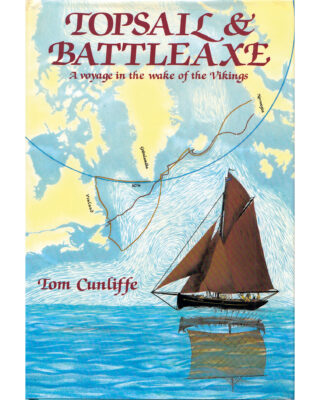
Topsail & Battleaxe, by Tom Cunliffe,
audiobook available from tomcunliffe.com

Rather than selecting an extract from the part of the book describing storms and ice off Greenland with my highly colourful crew, I have instead opted for one of the greatest feats of seamanship of all time which is analysed in the book, the voyage of Bjarni Herjolfson.

His vessel was a 55ft knarr, typical of the redoubtable Norse merchant ships of his day; commodious, seaworthy and surprisingly close-winded, she became the first vessel from Europe to sight America.

Bjarni and his father Herjolf ran a trading business between Norway and the relatively new colony of Iceland. Bjarni took care of the seafaring, his father operated the onshore side of the show at home in Iceland.

Meanwhile, Eirik the Red, a first-generation Icelander was following his father’s footsteps by indulging in a little murder and mayhem. To avoid the inevitably unpleasant consequences, Eirik opted to leave and set up a new community in south-west Greenland. For reasons obscure, Herjolf went with him, leaving a vacuum in the business when Bjarni arrived in Iceland loaded with trade goods.

The evidence for my reconstruction of Bjarni’s subsequent voyage comes from the Icelandic sagas. These have been picked over by many authorities who have drawn various conclusions. I have approached the matter from the point of view of a seaman who has been there in a sailing vessel of modest performance and, as folks say, ‘done it’.

Bjarni’s knarr, of course, had neither log nor compass. Although he had no longitude, he was able to determine a rough comparative latitude – no numbers you’ll note – by using a stick held at arm’s length in Bergen and making a mark at the height of the pole star.

Since both that port and Cape Farewell in Greenland stand at the same latitude (around 60°N), and Polaris does not move significantly, it follows that a heading of east or west from one will find the other. In the absence of measured miles, the Norse at this time reckoned their distance run on the basis of a day’s sailing. This was known as a doegr, which I take to be 24 hours sailing for an average vessel.

In the real world of sail and oar, this would be around 100 miles. A knarr driven hard with a fair wind can manage far more, but one must look to the average with no auxiliary engine. In any case, it is a flexible measurement.

Illustrations of Bjarni and his voyage are inevitably in short supply, so we have used archive photographs from my own trip to brighten our darkness here. We join Bjarni and his crew arriving in Iceland to discover that the expected backup and sales team have flown the nest.

When Bjarni Herjolfson’s deep-loaded knarr fetched up in Iceland in the summer of 985 her arrival was the culmination of a two-year voyage. In addition to anticipating payday, his men were looking forward to being reunited with their loved ones and seeing how affairs had proceeded in their absence.

For Bjarni, Herjolf’s defection also raised questions concerning the future of the shorebased side of his business and he saw two alternative courses of action. Either he could write his father off as having gone soft in the head by following that lunatic Eirik the Red, or he could sail his ship and his trade goods west after the colonists.

It seems likely that, in his note to his son, Herjolf included some words of encouragement about the benefits of keeping the family concern together. If Bjarni made it to the new colony with his ship-load of goodies from the homeland, the Greenlanders would surely be ready to pay top prices for them.

Article continues below…

Ten years or so ago I was contacted by a Finnish yachtsman, Tapio Lehtinen, who was seeking assistance with his…

Christian Williams, now 81, is alive, well and going strong in California. To get a handle on this remarkable man,…

A man of Bjarni’s business acumen cannot have vacillated long over such a decision and, rather than unload the knarr, he put his thoughts to the crew for their consideration. The Vikings preferred to run their deep-sea vessels with a limited degree of democracy and, to a man, Bjarni’s shipmates voted to go with him to Greenland.

That they did so in the face of the inevitable tongue-clicking and head-shaking from the usual gang of Job’s comforters on the dock is a tribute to Bjarni’s leadership. The crowd on his knarr were not just a few out-of-work Vikings dredged up from the bars of Bergen and Trondheim; they were a happy crew content to stick together. Above all, they were professionals.

In Bjarni’s day there was no ice to worry about on this passage and, in due course, nature sent him the pleasant easterly he had awaited. For three days and three nights the fair wind held, as Bjarni had been reasonably certain it would. Now they were entering latitudes where, in late summer, the twilight deepens into darkness.

Bjarni knew he hadn’t much farther to sail before he had run his distance as the knarr creaked, dipped and surged along before the fine passage-making wind, but as the third 24-hour period out of sight of land drew to its close, the weather bit back at them.

The easy sailing breeze backed steadily into the north and it came on to blow. Fog drove down on the gale and soon Bjarni was faced with handling his ship through a serious storm. All navigational considerations went, so to speak, out the porthole.
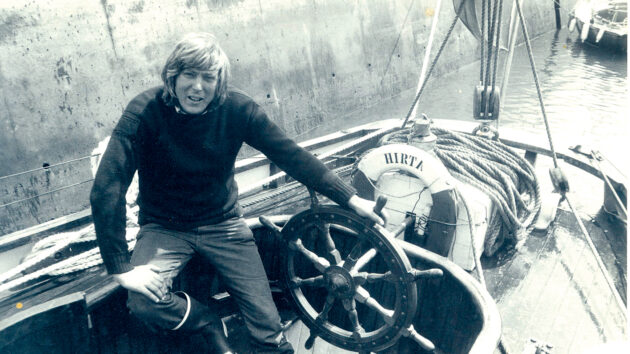
Back then: Tom Cunliffe in the cockpit of his pilot cutter Hirta. Photo: WM Nixon

Surviving the storm

At sea, there are various degrees of heavy weather, the worst being the survival storm. What exactly the wind force and sea state of a survival storm may be depends upon whether the unhappy mariner is in a 10,000-ton motor ship or a 10ft rowing dinghy, but whatever sort of vessel he is sailing, her limitations will soon become clear.

In a regular gale, a well-found sailing boat the size of a knarr can generally continue to make some way towards her destination, wind direction permitting, but if conditions become really bad the only consideration left in the skipper’s mind will be that of keeping her afloat and undamaged.

The last-ditch options have always varied with the type of vessel; the knarr had modest draught and was not fully decked; she also had no pumps, just a lot of dedicated Norsemen with buckets. The best way for her to survive a heavy storm must be to run before the wind, presenting her stern to the seas and lessening their force.
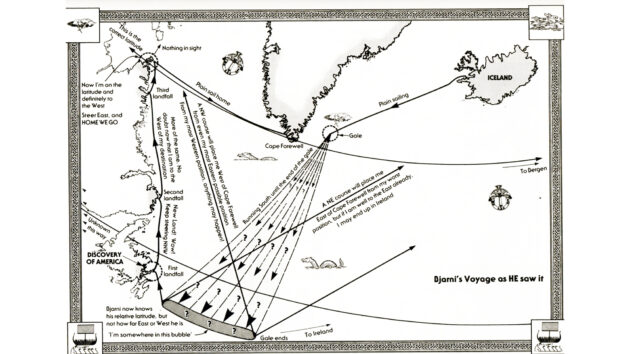
Illustration from Cunliffe’s book Topsail & Battleaxe showing Bjarni’s likely voyage to Greenland. Photo: Tom Cunliffe

Bjarni would have had recourse to these tactics on previous occasions, and that, not surprisingly, is what he did this time. Driving away under bare poles would keep him afloat: it would also run up many miles in, quite possibly, the wrong direction but this could not be helped.

It is by no means unusual for a boat of this size to make 5 knots downwind in a strong gale with no sails set. That means Bjarni was probably making between 100 and 150 miles a day.

Recalculating position

The storm lasted for ‘many days’. Because of the fog, the sailors would have had no idea in the end what the wind direction was, although winds of this nature that endure for such a time in the vicinity of Greenland and the Labrador Sea generally blow from the north-east. Bjarni, therefore, probably went scudding away to the south and west.

Like all gales the ‘northeaster’ finally blew itself out and the sun reappeared. It was immediately obvious to Bjarni that he was way to the southward of Cape Farewell.

Because the concept of even relative longitude was still centuries in the future, his chances of finding Cape Farewell by a straight shot were negligible. He had neither cross-coordinates for his present position, nor for where he was going. For a safe arrival his ship had to be placed on the same latitude as Cape Farewell, but that in itself was not enough.
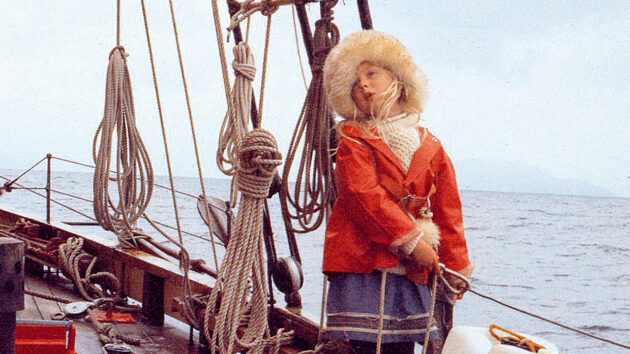
Cunliffe’s daughter, Hannah, dressed for the weather. Photo: Tom Cunliffe

When he reached that line he had to know whether the Cape lay to the eastward or the westward of his position. If he could be sure of which, then in order to arrive at his destination he had only to run down his latitude in the right direction until he got there.

Starting as he was from an unknown point well to the south, a course of north-east or north-west would place him sufficiently to one side or other of the Cape for him to be confident of which way to turn when he reached the desired latitude.

His reasoning now was quite simple. ‘If I sail north-east I may end up back in Europe, which would be grim for morale. Also, I will then have to work westwards against the westerly winds and the current. If, on the other hand, I trend north-west, the sea may well be empty of land – certainly none has been found so far – but if I find any at all it must lie to the westward of the south Greenland Cape because we know there is no land between the Cape and Ireland. If that happens I will only have to work north until I find the right latitude and then run down it to the eastwards.’

So that is what he did, and the following day Bjarni Herjolfsson became the first seaman from the Old World to officially set eyes upon the American continent.
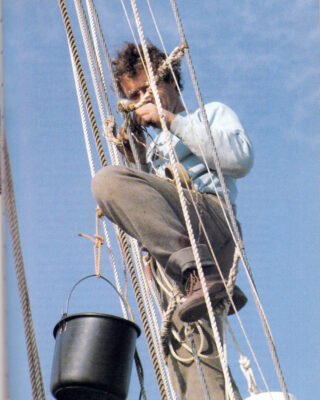
Chris Stewart freshens up the seizings on Hirta’s rig. Photo: Tom Cunliffe

Far away the land lay low on the western horizon. It didn’t look like the description of Greenland that Bjarni had been given and he knew the latitude was wrong, but his curiosity was naturally aroused and he sailed in for a closer look.

The mysterious country was well-wooded and the coast was backed by small hills. Seeing the stands of timber must have made him sit up because Iceland and, for all he knew, Greenland as well, were notoriously short of lumber of building quality, both for ships and houses.

However, with his knarr already deep-laden with high-value cargo, he had no room even to take on samples. Furthermore, the sailing season was growing old and he was anxious to get back to a known position, so he turned his ship’s bow to the northward and bowled away from the coast before a south-west breeze.
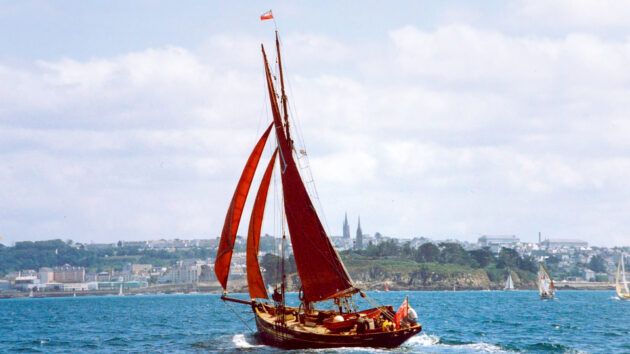
Cunliffe’s Hirta was a 35-tonne 1911 gaff-rigged pilot cutter. Photo: Tom Cunliffe

In order to make sense of keeping to his original plan he maintained his heading, and two days later he made another landfall. The hands, ever hopeful, jostled round Bjarni the navigator, asking him if he thought they’d made it.

“No,” he replied. “Greenland is full of snow peaks and glaciers. This surely isn’t it. Also we are many doegr to the southwards of the right height of the Pole Star.” But once again, he noted the wonderful forests that grew green right down to the water’s edge.

Shortly after closing the land the wind died and the knarr was left slatting and banging in the left-over swell. In spite of his desire to investigate what was clearly new ground, Bjarni had made up his mind that it was Greenland or bust for him. Any attempt to go ashore now would waste time and involve him in disciplinary problems rounding up the crew to sail onwards.

The hands, however, had other ideas. A deputation came shuffling aft to where he stood resolutely at the steering oar. “Here’s how it is, Captain,” growled the ringleaders. “The men think we should go ashore and see what there is. We owe it to the whole community, not just to ourselves.”

Bjarni repeated his decision and retreated not an inch. “All that’s as may be,” went on the spokesman, “but we’re going to need water and firewood before too long. We all say you should put in to the shore.”
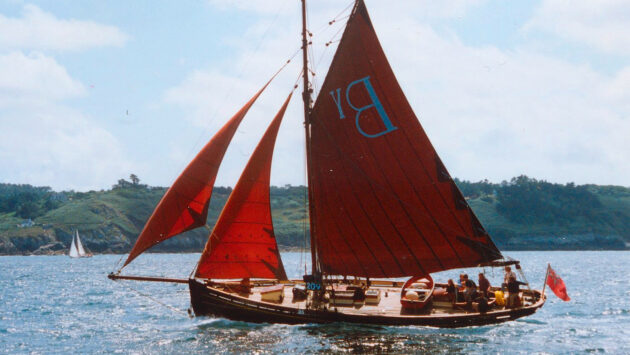
Cunliffe sailed Hirta to Greenland in 1983. Photo: Tom Cunliffe

Holding ground

But still Bjarni stood his ground. The men were outfaced and dispersed grumbling. Bjarni must have been wondering just how far he could push what was, in reality, a perfectly good crew who were merely reacting to an unusually frustrating voyage when, in the nick of time, a fresh breeze sprang up out of the south-west.

As it came on the spirits of the sailors rose with it as they always have done and always will do. Soon the confrontation was left astern as the ship sailed away to the north-north-west and out of sight of land once more.

They ran northward for three doegr while the Pole Star rose steadily towards the critical mark on Bjarni’s star stick. When it was nearly at the same altitude as at Bergen in Norway, they came upon what they took to be a third country.
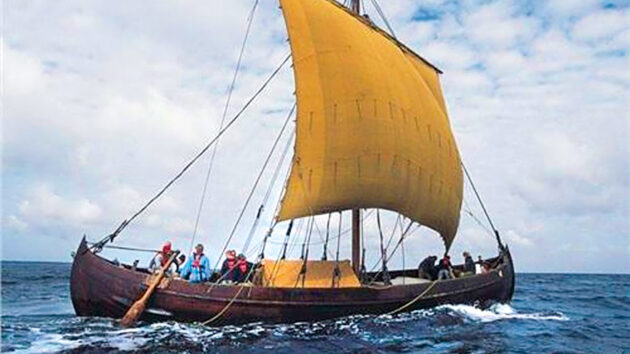
A Norse knarr could sail huge distances safely with a cargo. Photo: Tom Cunliffe

This time it was high, barren and topped with a glacier. The hopes of all hands would have soared. However, Bjarni must by now have been confident that he was substantially to the west of his destination and, after a while, he announced that this land was totally worthless.

What his long-suffering crew made of that statement is left unreported by the saga tellers, but just at the strategic moment when the skipper found his latitude and knew beyond a shadow of doubt that he must now turn eastwards, the coast fizzled out and he saw that the land he had been skirting was in fact an island, or at least nothing remotely the size of Greenland.

Any suggestion from the more unenlightened deckhands that they had been cruising northward along the east side of Greenland was thus put to ridicule and, with success assured, Bjarni set his course due east and blasted off out to sea before a rising gale.

Before long it was blowing old boots and the knarr was hard pressed to carry her canvas, but her able crew kept her driving, and driving in the right direction this time. Four days after leaving their final discovery astern, they came upon the imposing snow peaks that back the islands and fjords of Cape Farewell.
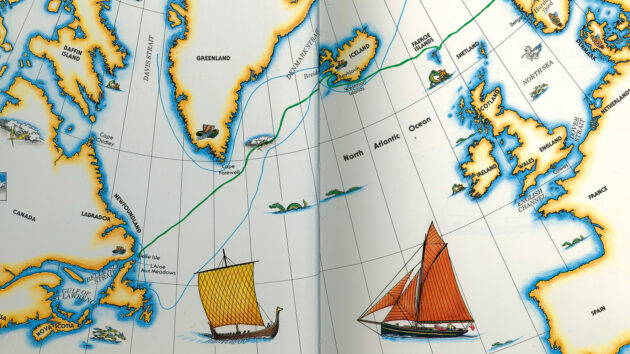
Cunliffe’s 1983 voyage reflected that of Bjarni in 985. Photo: Tom Cunliffe

There, lying on a promontory, was a small craft that Bjarni recognised to his great relief as Herjolf’s and, to a hero’s welcome, he brought his ship around what was now called Herjolfness and anchored in front of his father’s new home. Bjarni’s voyage is one of the greatest pieces of deductive navigation of all time, but in addition to his brilliant seamanship, he held his crew together and delivered his cargo in one piece.

He had fulfilled the purpose of his voyage and no sailor can do more than that, but during the long winter nights that followed, many of the Greenlanders began muttering among themselves. It was a poor sort of Norseman, they grizzled, who failed to deliver a full report on such exciting new discoveries. They were quick enough to criticise Bjarni, but it took many years before Eirik’s son Leif put his own life on the line and sailed south-west to find out for himself.


If you enjoyed this….

Yachting World is the world’s leading magazine for bluewater cruisers and offshore sailors. Every month we have inspirational adventures and practical features to help you realise your sailing dreams.

Build your knowledge with a subscription delivered to your door. See our latest offers and save at least 30% off the cover price.

Note: We may earn a commission when you buy through links on our site, at no extra cost to you. This doesn’t affect our editorial independence.


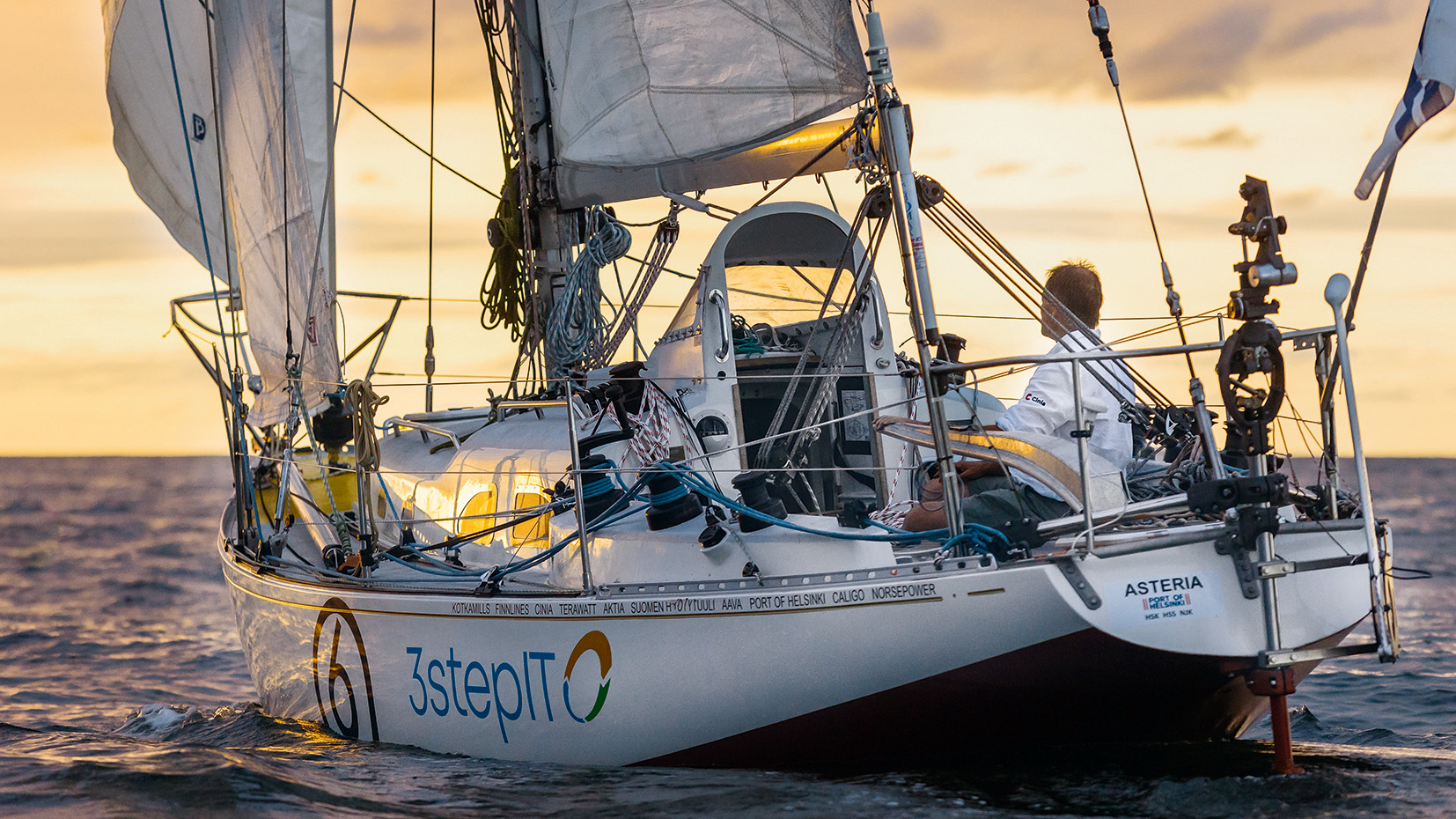
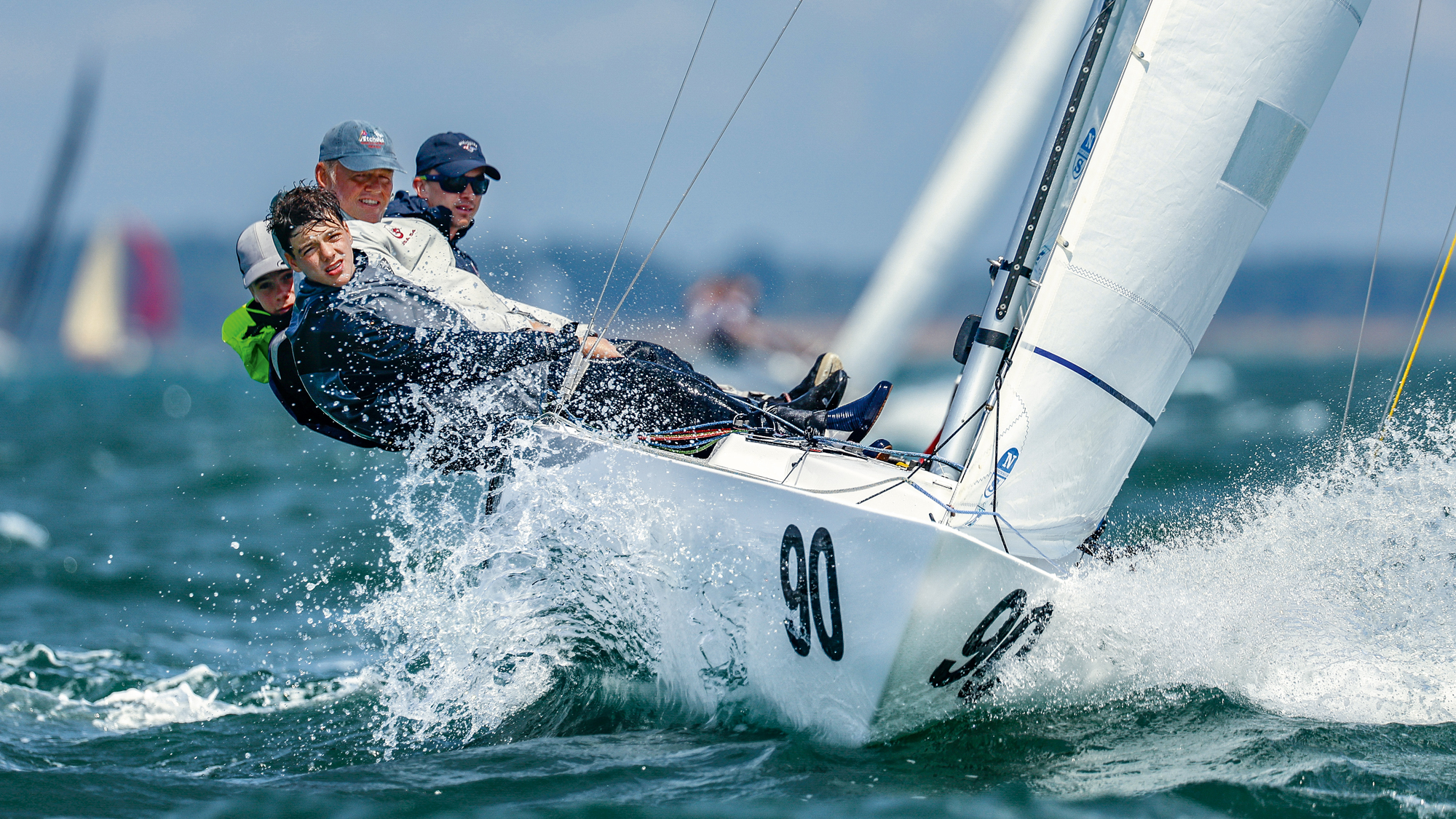
5 expert tips: How to be a yacht’s watch leader

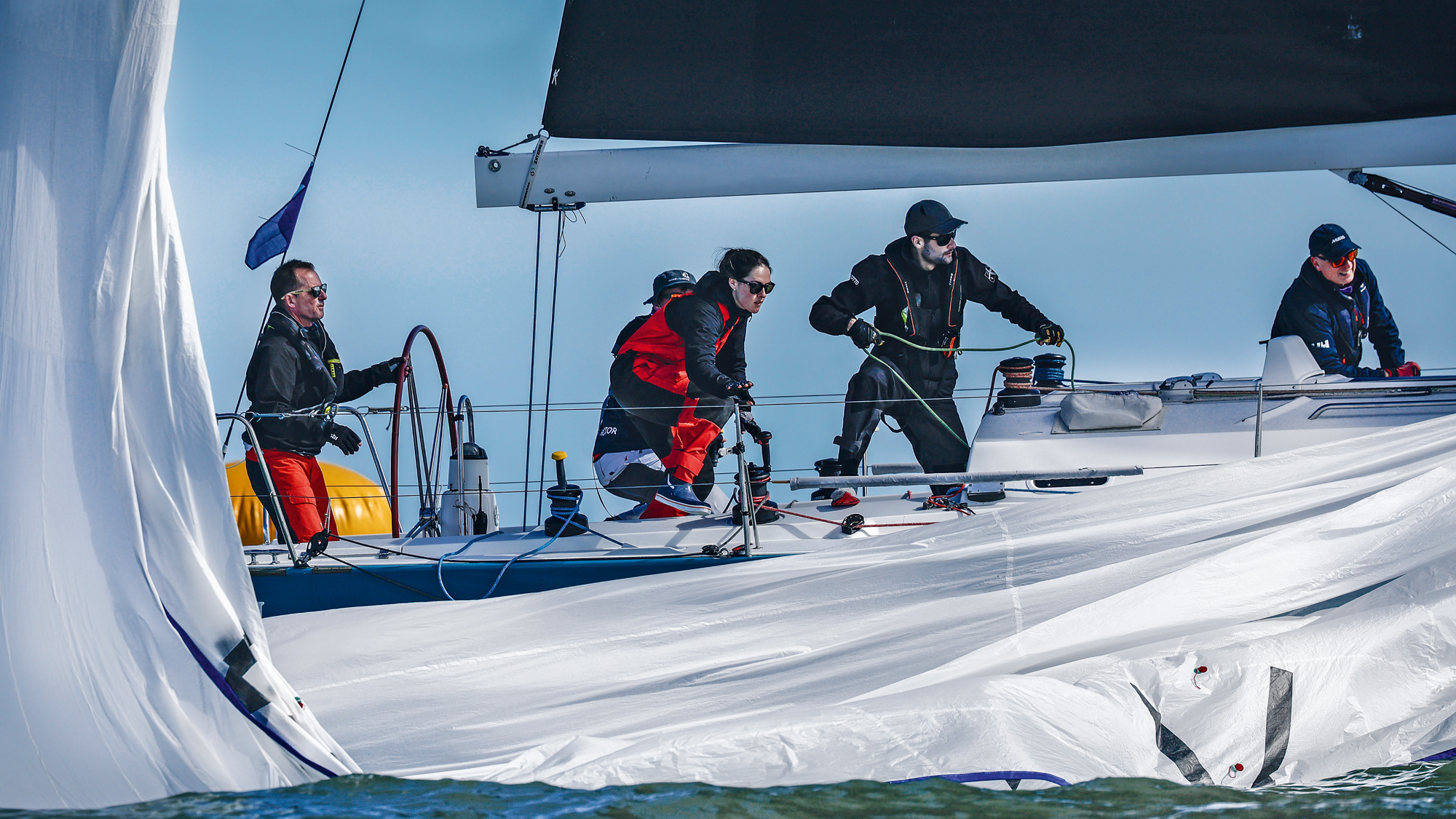
Although he’s the crew boss and watch captain of 100ft Maxi yacht Scallywag in his own right, Pete Cumming is always eager to learn from the best. After operating as a driver/trimmer on board Volvo 70 Tschüss 2’s line honours victory in the Transatlantic Race 2025 in June, he was inspired by the calm leadership of watch captains Neal McDonald and Stu Bannatyne.

“Neal and Stu are really good at making sure everyone on the boat is connected with the decision-making process, which keeps everyone motivated and all pushing towards the same objective. Which might seem really obvious, but I’ve been on plenty of boats where the front end of the boat has no idea what the people at the back are thinking.

“The moment Neal or Stu come off watch, they’re checking in with the navigator, Campbell Field, just getting an overview of what’s going on before they go to sleep. Are there going to be any sails challenges coming up in the next four hours while they’re off?”

Done right, the watch captain spans many roles, from co-ordinating the boat handling up on deck to making sure everybody on their watch is physically and mentally able to work to their best within a demanding and maybe even sometimes hostile working environment.

Here are Pete’s five key tips for being the best watch captain you can be.

Staying in the loop

I think it was Brad Butterworth who said that when a team breaks down, lunatics start running the asylum.

When there’s no communication through the boat, and maybe a lack of trust, you get in situations when the crew suddenly decide they’re going to call the gybe because the navigator’s asleep and you don’t want to disturb him. With the seasoned pros this lack of comms is never allowed to happen.

Article continues below…

Keelboat sailors obsess about maintaining the optimum angle of heel. According to Chris ‘Twiggy’ Grube, it’s a good obsession to…

You learn more from your mistakes than from your successes. But when you’ve had a bad result, how do you…

It’s the watch captain’s job to make sure the chain of communication is always operating smoothly. Splinter groups develop on boats all the time, but if you can work with the navigator and the guys on deck so that everyone’s got buy-in to the strategy and the decision-making process, it makes the world of difference to the atmosphere on board, and ultimately to the team’s performance.

Earn respect

To be an effective watch captain you’ve got to earn the respect of the people around you, and that generally only comes with experience, a sense of competence and a good deal of self-confidence without arrogance.
If someone questions you, you’ve got to be able to cope with that and not look weak with your decision-making. Sometimes there can be big egos on board and you have to be able to stand your ground. You also need to lead from the front and occasionally show the guys that you’re prepared to get your hands dirty and do a tough or unpleasant job yourself.

That said, it’s important to choose the right moment. Don’t go down a rabbit hole of trying to get one small job done if that takes your attention away from the big picture. That’s your main job. Ultimately you’ve got to have good knowledge of most areas on the boat, without being an expert at everything, which is why watch captains tend to be recruited from the middle of the boat – a trimmer or someone who’s worked in the pit area who’s connected to the front and the back of the boat and understands the challenges of both ends.

Questions, not commands

A good watch captain empowers his team to make their own decisions, to run their own part of the boat as best they can. You have to be able to ask questions of each other, to check in on each other and ask for thoughts and ideas rather than pretending that you’ve got all the answers.

Stu and Neal are brilliant on watch and they might ask me: “Pedro, question for you: is the staysail over-trimmed? I’ll leave it with you.” It’s not an order, it’s a prompt. So I’ll go forward and I’ll see if the staysail needs a bit of an ease. They’re very good at empowering every team member to make their own decisions.

Keep it fun

Sometimes you can forget why you’re out there. We do this because it’s fun, and it has to be fun for all the crew. You might be capable of extracting the best performance in the world, but if you’re a miserable bugger you can shut that watch down pretty quickly. It reaches a point where everyone just counts down the minutes until they can go off watch.

Don’t be that person. Keep it fun, maintain an open dialogue where everyone feels comfortable talking to everyone else and enjoying each other’s company.

Have a quiet word

If there’s a bad atmosphere, as a watch captain you need to get to the root of the problem quickly. If someone is playing up or not fitting in with the team for whatever reason, the worst thing you can do is try and shame that person in front of the crew. It’s not always easy to find a place on board to have a quiet word with them, but that’s the way to approach it.

Find your moment to hear what they’ve got to say, because sometimes the reason for the upset can be completely different to what you might have imagined. Most people will appreciate the fact you’ve tackled the problem head on.


If you enjoyed this….

Yachting World is the world’s leading magazine for bluewater cruisers and offshore sailors. Every month we have inspirational adventures and practical features to help you realise your sailing dreams.

Build your knowledge with a subscription delivered to your door. See our latest offers and save at least 30% off the cover price.

Note: We may earn a commission when you buy through links on our site, at no extra cost to you. This doesn’t affect our editorial independence.


10 essential multihull sailing skills you need to know

Nikki Henderson on the essential multihull sailing skills you shouldn’t set off without for smooth catamaran or trimaran cruising

The plan is simple: buy a boat and seek out your best life. You’ve decided you want a multihull, for the space and stability that offers.

Your other key requirements are comfort – a yacht you can live aboard for months – and a multihull that’s bluewater capable so you can explore wild remote places. It has to be safe, of course. And spacious enough for you, your partner, maybe your kids (and perhaps someone to help look after them sometimes), or a few friends and family. After all, adventures are better shared.

Bonus items? If the budget allows – performance, please! A fast boat means less time at sea (critical for keeping the non-sailors happy). Faster means more fun, but also the faster you sail the more flexibility you have for weather routing. So speed equals safety.

If this all sounds familiar, that’s because many Yachting World readers dream of the same thing: a bluewater catamaran, powering through the miles, and the freedom of an endless horizon.

Every year, I work with hundreds of people chasing this dream. And wow, it’s a big project! Most begin with hours upon hours, if not weeks, lost to YouTube and online reviews, comparing boat brands. Once committed, the number of decisions to make and to-do list items explodes.

What modifications or custom options will you want? Do you want gas or all-electric? How many cabins do you need, and what layout suits you best? What sails do you need? Who to make them? Then there’s electronics, spares, tools, toys, logistics… and how to leave behind your land life.

Buried in logistics and yard work, cruisers often fall into a common trap: time and time again they forget the sailing element.

Many new catamaran owners are experienced monohull sailors but new to multihulls. Others charter in the Med a few times a year but have never owned their own boat. Some haven’t sailed in years – kids and work got in the way. Some, incredibly, are total beginners.

Article continues below…

What are the best bluewater multihulls for long term cruising? The one you own, or the one you can afford…

There are many categories in the European Yacht of the Year awards, from the best luxury yachts and performance yachts to the best yachts for families and evet…

So when the boat finally arrives or the jobs list is finished in the yard, most owners are exhausted and over-excited. Their sailing skills are rusty. But, at that point, taking the time to polish up their boat handling is not what they want to do. Understandably, they want to slip lines and go.

The problem is that a lack of skill and confidence can lead to a bumpy first couple of years cruising. The best case scenario – if they’re lucky – is that only the boat gets bruised. I’ve seen many boats listed for sale within two years.

Two things matter most to the success of your bluewater experience:

  • The brand and model of catamaran you buy
  • Your sailing and cruising skills

Your skill and confidence will make or break your experience – and your crew’s too. Here are the 10 top skills to polish before casting off.

Leaving or manoeuvring in a marina – and dealing with twin engines – is likely to be your first test of handling skills with your new catamaran. Photo: Richard Langdon

Docking a catamaran with Twin Engines

Leaving the marina is going to be the unavoidable first step. The departure sets the tone. Nail it, and there’ll be a good feeling in the air.

Twin engines take some getting used to. First, forget your rudders: lock the helm straight and steer with the engines. Famously, cats can spin on the spot. But it rarely turns out quite as advertised… high topsides, no keel, and light bows mean your ability to pivot is often negated by windage and drift.

Once you figure out how to use the limitations of a cat to your advantage you’ll love the double engines. Practice is key.

Catamaran docking tips

  • Stern to wind is your mantra. Keeping the stern facing the wind makes the boat more stable and easier to control.
  • Park in reverse. Stay stern to the wind, and you have better visibility and comms with the aft line handler.
  • Skip the ‘spin’. Where possible, use a 3/5/7-point turn with one engine at a time. It’s simpler, less confusing and thus less risk-prone. And you can keep the boat to windward of the tight space within your turn.
  • Use one hand. Traditionally, driving multihulls was taught with two hands: left hand left throttle; right hand right throttle. Change this to one hand. Then you can move around, twist your torso, see, communicate and park successfully.

Multihulls are becoming increasingly popular for sailors taking on an Atlantic challenge – here setting off on the Atlantic Rally for Cruisers (ARC). Photo: James Mitchell/WCC

Wind angles and routing

Factory polars can be shocking. “50° to windward?! How will I ever get upwind anywhere?” you wonder. Well… yes… catamarans are reaching machines. They don’t point well. Daggerboards help a lot with upwind performance. But even then, crack off 10° and they fly.

Don’t blame your tools. Learn how to use them. So how to best leverage this?

Sail more miles, faster. Cracked off = big speed gains. Sometimes you can still reach a windward destination faster than a monohull of similar length by using this technique.

Wait it out. If a shift is coming in the next few days, consider delaying your departure. Then enjoy a fast few hours of downwind sailing, rather than the 10 hours slog you initially signed up for.

Don’t pinch – it doesn’t work. Accept your angles and see if you can outsmart your own plan. If you do ever see a cat pinching, don’t be fooled. They will be using the engine for assistance.

Multihulls are weight sensitive so try to keep heavy items central and low. Leading anchor chain aft away from the bows is prudent. Photo: GLY

Weight management

Cats are wider, roomier, and generally have more space for more stuff (much of which you probably don’t need). But they are also lighter, and more weight sensitive. All this means there is a lot to consider when it comes to stowage.
If you are a monohull sailor, be prepared to pay just as much, if not more attention to how much and where you add extra weight on board.

Catamarans are typically lighter displacement than a monohull of equivalent length, and so extra weight on board will have a greater impact. And, unlike a monohull which relies on its keel for stability, a catamaran relies on its beam. Therefore, loading the catamaran with weight aloft, or not distributing it evenly across both hulls, will make it more prone to heeling and reduce its stability.

What to do

  • Live minimally. Be ruthless about what comes aboard. Once ‘stuff’ (the usual culprits are extra kitchen equipment, doubled-up tools and spares, shoes you never wear, water toys you never use) comes aboard, you will feel a sense of ‘loss’ to take it off. Save yourself the grief, and never let it on.
  • Keep the ends light. I know they are roomy and no one sleeps there. But they are empty for a reason! Weight needs to be central, and low. Consider storing the outboard motor off the tender and use bow lockers for light gear only.
  • Balance port and starboard. One hull shouldn’t carry your whole life. Check from astern on a calm day that your boat isn’t listing.

Reefing early is vitally important with a catamaran. Photo: Marianne Urth

Reefing a multihull

Cats don’t spill any power via heeling. They just power up, until they flip. And that is why reefing is key. Reef proactively. Set strict wind speed reefing thresholds (lots of manufacturers recommend these).

But don’t be afraid to err on the more cautious side, as the guidelines rarely take into account sea state.

Multihull reefing tips

  • Topping lift! No vang means the boom drops hard onto the roof without it.
  • Mainsails don’t drop easily. There is a lot of friction due to full battens compressing mast cars, and probably a 2:1 halyard. Consider using downhauls on the luff or upgrading mast cars to ones with roller bearings and using the reefing line to coax the sail down. If all else fails, you can change course upwind but be cautious of the increased apparent wind when you do that.

Keeping weight out of the ends is key for sailing performance. Photo: GLY

Depowering a multihull

As aforementioned, gusts don’t spill power on a cat – they load it up. Multihulls can take a lot, but the line between everything being fine and not fine is sudden. You need a fast, simple depowering setup in case of any unexpected gusts or squalls.

The previous advice was to reef early – but we aren’t always good at that. So you need a plan if you get caught out and miss the window of opportunity to reef.

Multihull depowering tips

  • Active sheets. Keep these on winches with the clutches open – always the mainsheet and headsail/spinnaker sheet.
  • Traveller dump. The windward traveller line should also be ready to dump. In a gust, this can be your first move because it’s in the cockpit where you also are likely to be.
  • Bear away. Go for a quick bear away as soon as you’ve depowered the sails to reduce the apparent wind. Practice hand-steering this.
  • Turn downwind fast. Quickly straighten the helm the moment you don’t feel the wind on your windward cheek.
  • Daggerboards. Keep the leeward daggerboard line on a winch ready to quickly raise it to avoid tripping.
  • Depowering. For kites and gennakers, set up quick-release tack systems for instant depowering.

Catamaran sailing is all about the fun –especially downwind, when properly set up. Photo: Jean-Marie Liot

Downwind sails

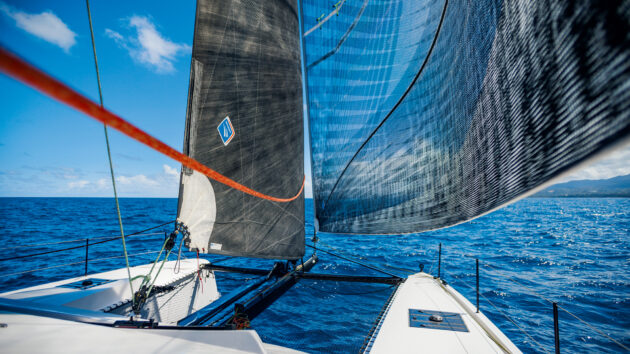
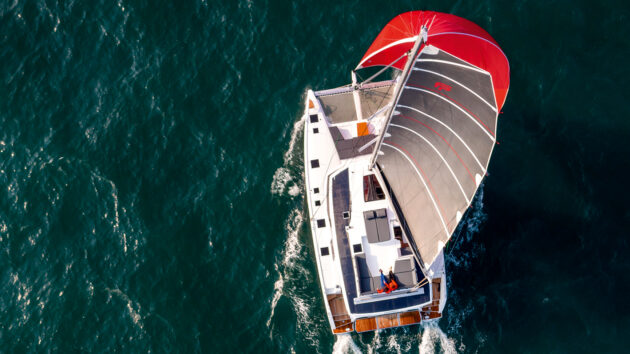
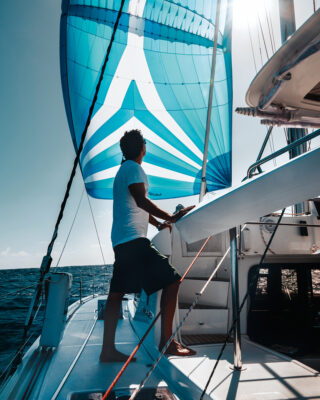
Cats sail downwind like a dream, so it’s time to embrace that. You’ll be especially thankful for your and your crew’s proficiency with the spinnaker or Code 0 when the winds soften and you have a long ocean passage ahead of you.

Any monohull sailors might underestimate the gains to be made by flying downwind sails. But a few knots can make a big difference over 3,000 miles. Anyway, you are out of excuses! Cats are stable, the bow is safe – and with its big soft nets, it’s even kind to your knees. There’s no justification for not going up there and giving this a go.

Downwind catamaran tips

  • Practice the drop. If you know you can get it down, you overcome the fear of putting it up. This might include using socks, furlers, or a traditional drop to douse the offwind sails. Nail them all!
  • Optimise your systems. Make hoisting, flying and dropping these intimidating sails easier – reroute lines if needed, add Martin Breakers (a quick-trip shackle to release tack line under load) and use electric winches if that helps smooth
    the routine.
  • Learn the angles. The more you understand about what wind strengths and angles your sails love, the more likely you’ll be to fly them. Get as much data as possible, or a sail crossover chart from your sailmaker. And also keep a good log and note your own numbers.

No excuses to go without a kite. Photo: Saskia Stainer-Hutchins

Feedback cues

We’ve all been there. You go off watch with the boat sailing peacefully in 10-15 knots. And you wake up having fallen out of bed, the boat heeled over hard, in 20 knots upwind. You will now reminisce on those days with fondness. As a catamaran sailor, you are going to have to master the art of subtlety. Specifically, interpreting less obvious feedback that the boat is overpowered or underpowered.

Tips for tuning in

  • Use the instruments. But don’t use them in isolation. Boat speed and wind speed tell you a lot and it’s critical to respond to them with reefing (see point No4). However, you can also sense a few degrees of heel, a change in acceleration, or a shift in pressure with your body. The less reliant you are on instruments and the more intuitive your relationship is with the boat, the safer you will be.
  • Use your hearing! Listen for slamming, rig hum, and the frequency of the wave slap.
  • Log what you ‘feel’. Log regularly and include wider information so you can look back and compare. For example, if a few weeks ago you were happily eating dinner with no reefs in the main, what’s different this time? The sea state? Your fatigue? Intuition?
  • Power down early. Comfort trumps speed on cruising boats 99% of the time (which can be hard to adapt to for successful, driven people). But remember the dream – it’s usually a version of ‘slowing down’.

Living the bluewater dream, anchored in an idyllic spot – and catamarans can drop the hook in relatively shallow water. Photo: Robin Christol/GLY

Manoeuvres

Two hulls change things when it comes to manoeuvres: tacking is slow, gybing is violent. You need to get comfortable with it all.

It’s not uncommon to find catamaran sailors who avoid manoeuvres at night. That’s great in theory – until you sail into a wind hole, or want to avoid a squall, or need to miss a cargo ship. Really every bluewater sailor needs to know how to complete manoeuvres in all conditions, at any time of day.

Upwind Manoeuvres

Build up speed before the tack and use it to carry you through. Remember, angles are wider and the turn may well be more than 100°.
If you have them, and they aren’t already down, drop both daggerboards to the same level. It gives you some grip during the turn.
Back the jib through the tack if needed (unless it’s self-tacking, in which case get creative with a handybilly or extra control line).

Downwind Manoeuvres

With a square top, big roach and full battened mainsail, gybing can be exciting. The main needs a lot of control through the gybe. Centre the traveller and make sure it’s locked off on both sides, tighten up the mainsheet, gybe – then control the sheet to dampen the slam when it flips to the other tack.

A remote-controlled windlass will be a big help when retrieving and viewing your anchor tackle, while headsets help maintain communication with the helm. Photo: Saskia Stainer-Hutchins

Catamaran anchoring

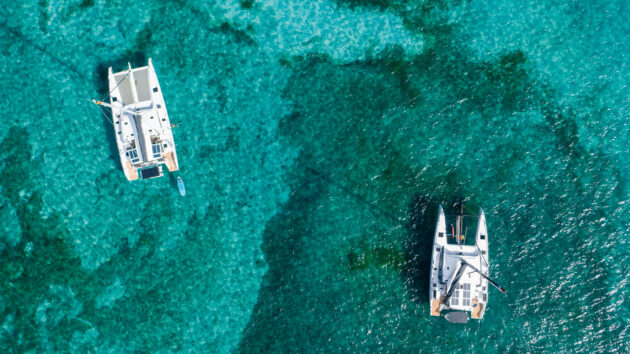
Most cruisers are at anchor about 80% of the time, even if they are ‘sailing around the world’! It’s a critical skill, and a core element of living the dream.

But in order to spend your days swimming off the back of the boat or enjoying serene sunset cocktails on the bow – and to comfortably sleep, make repairs, and live on the hook – you need to be able to anchor confidently, reliably and securely.

Making sure the hook is properly set will ensure a more relaxing time in that idyllic anchorage. Photo: Kinetic Catamarans

Catamaran anchoring skills

  • Set it properly. Use 3-7 times the depth. Reverse hard on it (1,500-2,000rpm) – better to drag and find out it’s not holding now, rather than at 3am.
  • Find space. Choose a spot with not too many boats around. If there are, make sure they’re catamarans too as similar hull shapes swing similarly. Resist the temptation to be too close to the beach in the crowds (instead, get a fast tender and learn how to use it).
  • Always use a bridle. If it isn’t already set up, attach a mooring line of identical length to each bow cleat and tie both to the chain in the same place with a prussick knot or rolling hitch.
  • Float the chain. Learn to float the chain in preparation for the reef-laden anchorages of French Polynesia or other heavenly spots. Use a couple of traditional heavy plastic fenders at about 10m increments.
  • Shorelines. Know how to set up a shoreline to control your swing. This will open up the tighter anchorages, or the deeper ones, which can be beautiful. Anchor as normal and then head ashore with a long line and tie it to something stable like a tree or a rock.

Photo: Lagoon Catamarans

Enjoy the comfort

Sometimes sailors can be a bit masochistic. Let that go. This dream involves two hulls – it’s time to get comfortable.

Before departure, try to relax. You don’t need to prep every meal in advance and psychologically prepare yourself for beyond three or four days of the usual motion sickness. Instead, think about activities to keep everyone busy and entertained.

You can cook, bake, eat, sleep, do yoga, workout, learn the guitar, or dance while underway (yes, I’ve done all of the above). This is a lifestyle.

Just one thing to remember: when sailing downwind the wind funnels through the saloon, so card games don’t work so well. Everything else? Go for it.

I feel so lucky to have spent so much time around people making this dream into their reality. It’s inspiring to see people brave enough to go after more from their life. So if you want to make that dream last you’ll need to invest in the skills to make it work. Docking, reefing, routing, anchoring – mastering these techniques will add a layer of safety, confidence and ease to your experience.


If you enjoyed this….

Yachting World is the world’s leading magazine for bluewater cruisers and offshore sailors. Every month we have inspirational adventures and practical features to help you realise your sailing dreams.

Build your knowledge with a subscription delivered to your door. See our latest offers and save at least 30% off the cover price.

Note: We may earn a commission when you buy through links on our site, at no extra cost to you. This doesn’t affect our editorial independence.

Chat/call The AYB Team