Best Waterproof Duffel Bag 2025: Keep your kit dry on the water

We sailors know a thing or two about soft luggage. The best waterproof duffel bag though is really a matter of functional practicality fused with personal taste

The demands of water-based activities—be it a long weekend of sailing, a white-water kayaking trip, or an afternoon spent paddleboarding—all require one essential piece of gear: reliable, durable luggage. While specific needs might call for a completely waterproof backpack or a minimal roll-top dry bag, for most adventurers, a favourite solution is the best waterproof duffel bag they can find.

A great duffel provides a wide-mouth opening for effortless packing and unpacking of bulky kit like wetsuits, dry suits, and technical waterproof jackets. Crucially, it must protect your clothing and electronics from moisture, whether that’s a quick soaking in a tender, relentless rain, or sitting in a damp locker below deck.

We’ve tested this extensive line-up of the best waterproof duffel bags, ranging in size from a compact 30L for essentials up to a massive 130L expedition capacity, to help you find the perfect bag.

Our guide breaks down the core compromise: fully waterproof bags feature welded seams for maximum protection (ideal for dinghy sailors and kayakers) but fewer pockets, while water-resistant options offer superior organisation and convenience through traditional sewn seams. We look at the top models from Helly Hansen, Lomo, Overboard, and more to ensure your gear stays dry on your next aquatic adventure.

At a glance – Our 3 top choices for best duffel bag

Best 30L – 40L Waterproof Duffel bag 


Helly Hansen Duffel Bag

Specifications: Capacity: 30L | Dimensions: L 50 x H 27 x W 27 cm

Reasons to buy: Good amount of storage for essentials |  Hardwearing and long lasting
Reasons to avoid: Seams aren’t waterproofed so they can’t be exposed to water for a length of time | Handles are stiff and it can get in the way of straps.

The Helly Hansen 30L duffel is made from a sturdy plastic canvas. so it is water resistant to a degree. Though the seams aren’t waterproofed, so it isn’t advisable to dunk this bag for any length of time.

The rucksack straps neatly stow away into the zip flap on top, though this makes it a bit stiff to handle, it does get those straps out of the way, especially when you’re onboard and you want them flailing around. Under the top flap there’s a mesh pocket too. I find this useful to stow my sailing gloves, buff and hat.

In the cold the material on this bag can get quite stiff. But, mine has stood the test of time so far, as can be seen in the pics at the top of this buyer’s guide. The purple bag is the earlier model to this one. They’ve improved the bag by adding webbing straps and handles on each end which is handy for strapping it down to stop it flying off a bunk.

Lomo 30L White Holdall Duffel Waterproof Rolltop Dry Bag

Specifications: Capacity: 30L | Dimensions: ‎L 52 x H 28 x W 31cm

Reasons to buy: It’s a budget-friendly buy | The duffel bag has good waterproofing
Reasons to avoid: Would benefit from additional storage compartments | As the material is thick, the bag can be stiff during the winter months

This 30L dry bag duffel from Lomo is incredibly good value for money. You get fully welded seams and a roll top closure. This gives all the advantages of the wide mouthed duffel with waterproof submergibility.

I personally love a white bag when I’m heading into dark spaces, such as yacht cabins. It means you can see the contents inside your bag more easily. Whilst this duffel doesn’t have the practical additional pockets of the other non-waterproof duffels, the trade-off is worth it if you are planning on going for a wet ride or need to put your luggage where it will get wet. Those of you sailing smaller J boats, I’m looking at you…

The other trade-off with this type of waterproof bag is that by its very nature, to enable toughness and strong welded seams, the material must be a certain thickness. This can make the bag feel quite stiff. Particularly in colder weather. This duffel doesn’t have rucksack style shoulder straps but does have a removable single shoulder strap and plenty of webbing to cinch it tighter and places you can tether it to your bunk to keep it in place. Some folks have used this as a pillow by trapping air inside.

Gill 30L Team Bag

Specifications: Capacity: 30L | Dimensions: H 31 x W 52 x D 27cm

Reasons to buy: Perfect bag for small voyages | You can attach parts of your kit to the webbing loops
Reasons to avoid: It doesn’t have rucksack straps making it harder to spread the weight from the contents of your bag | The waterproofing isn’t as effective if the roll top isn’t secured correctly | It’s a small bag – avoid it if travelling on a longer trip

This small holdall from Gill is made from PVC with welded seams and roll top to give a waterproof duffel.

It has a removable shoulder strap, but as with the other waterproof bag in this size, it doesn’t have rucksack straps. The roll top keeps a watertight seal and can be used to trap air inside the bag making it buoyant or useful as a pillow.

It features some handy webbing loop handles on each end plus additional webbing loops to attach other bits of kit to. On one side it also had a label window so that you can put your name on it to identify its owner.

The welded PVC is a little stiffer in the cold and can be tougher to handle, but when warm it’s handles very nicely.

Victorinox Touring 2.0 Travel 2in1 Duffel

Specifications: Capacity 38L | Dimensions: H 28 x L 32 x W 57cm

Reasons to buy: The side pockets are a bonus as they help you to keep your bag organised | Rucksack straps distribute weight, good news for anyone carrying a lot of gear | It makes a great gift due to the personalisation
Reasons to avoid: Expensive

Victorinox don’t shout very loudly about their luggage. Indeed, if you go to their website, they don’t smother you with sales guff. They let their products talk for themselves.

This premium priced duffel from this Swiss knife maker is every bit as innovative and full of hidden handy bits. You can read what I think about their Skippers knife here

There’s a shoe pocket, lots of organised side pockets, pull out hidden rucksack straps, or a detachable shoulder strap. There’s a waterproof internal document pocket. And, if you’re into personalisation, there’s a little plastic thingyme-jig that can be customised with your own name or message on it that is attached to the bag.

Overboard 100% Waterproof Classic Duffel Bag

Specifications: Capacity: 40L | Dimensions: ‎L 52.07 x  H 32 x  W 23.11cm

Reasons to buy: Durable duffel which will stand up against all types of weather | Great for kayak or paddle boarders due to its excellent waterproof functionality
Reasons to avoid: With its smaller capacity, we wouldn’t recommend it for longer trips

A 100% waterproof welded seam duffel bag with roll top closure. Overboard have this rated to IP66 so you can be confident that if you’re luggage is sitting a pool of water in the wet locker of a boat, your kit will still be dry inside. Equally if it gets repeatedly dripped on by a leaking hatch, as long as the top is rolled over correctly and fastened, then your kit will remain dry.

It’s been designed for a bit of rough handling and should stand up well to the rigours of frequent use in wet conditions. Ideal for carrying wet gear back with you too, so if you go open water swimming, surfing, or kayaking and find yourself needing to pack a wetsuit and wet gear, then shove them in this for the journey home and your car will remain dry.

The attachment points on this bag also enable you to strap it down, so it either won’t fly out of a bunk or it will remain strapped to your touring kayak or paddleboard.

Best 40L – 65L Waterproof Duffel Bag 

Helly Hansen Offshore Waterproof Duffel bag, 50L

Specifications: Capacity: 50L | Dimensions: L 28 x W 64 x D 28cm

Reasons to buy: Lots of room to put your gear in | You can load and unload the bag effortlessly
Reasons to avoid: The duffel doesn’t guarantee complete protection if submerged in water | Some compartments would be beneficial for storing smaller tools and essentials

Helly Hansen do a fair range of waterproof duffel bags. This middle of the size range duffel is a version with welded seams and a roll top.

It can sit in pools of water all day and your kit will stay dry.

They suggest it can be strapped to a car top and it remain waterproof too, though I haven’t tried this so can’t verify whether kit will stray dry with rain pelting it at 70mph on a motorway.

As per other welded waterproof bags, this one isn’t designed to be fully submersible but it is as waterproof as you can get without full dunking.

It has end handles which are useful for strapping the bag down, but very few other bells or whistles.

There’s no rucksack straps with this, but there is a removable shoulder strap.

Red Original Kit Bag

Specifications: Capacity: 60L | Dimensions: L 76.5 x W 33 x H 29.5cm

Reasons to buy: One of the lighter options we tested | Made from recycled TPU | Plenty of storage for a first aid kit, towel and more
Reasons to avoid: It’s easy to forget to pack the waterproof padded mat | Waterproof zip closure rather than roll top

If you watch the Red marketing hype you’d think this bag will make you a paddleboard, camping and hiking expert and all round wilderness guru.

In this bag we are given a waterproof zip closure rather than the roll top of other 100% waterproof bags. It has welded seams as the others do, but it is made from a slightly lighter weight material.

It has a waterproof padded mat inside it which can be removed and used as a changing mat to stand on.

The Red Equipment bag has a range of strap options, including rucksack straps and shoulder strap.

There’s some mild eco credentials on this as it is made from recycled TPU. Though I guess those credentials need thoroughly scrutinising as who knows where this bag was made and how many air miles it took to get to you.

The bag does pack some seriously good organisation and innovation though, with high quality components used and sturdy long lasting fasteners.

Typhoon Osea Dry Duffel Pack 60L

Specifications: Capacity: 60L | Dimension: L 70 x W 32 x H 56cm

Reasons to buy: Good value for money | Excellent waterproofing thanks to the 500D tarp and roll top functionality | Along with the rucksack straps, the waist straps transfer the weight from your back to your hips
Reasons to avoid: Not the most stylish duffel on this list

The Typhoon Osea Dry Duffel is made from 500D tarp which is 100% waterproof.

This roll top bag is 100% waterproof and comes with removable rucksack straps as well as waist straps, which is very handy in any rucksack with a larger capacity.

This duffel also comes with an unusual buckle attached to a chest strap that has a built-in whistle. This is a nod towards Typhoons origins as a commercial safety gear manufacturer.

A feature I really like on this duffel is a compression valve, which means you can sit on this bag and squash the air out of it, close off the valve and you’ve saved a ton of space in the cabin.

I like the understated functionality of this bag and whilst it doesn’t shout style appeal, it really is a great duffel for keeping your kit dry, or for keeping your wet kit from leaking all over the place.

Specifications: Capacity: 60L | Dimensions: ‎L 64 x H 34 x  W 34 cm

Reasons to buy: Budget friendly | Bungee loops to help you secure your bag | Room for plenty of essentials thanks to its large capacity 

Reasons to avoid: Not fully submersible with its waterproofing

This Lomo orange duffel is made from waterproof material with welded seams on the sides. This means the bag can sit in a pool of water without letting any in.

It isn’t submersible though as this has a zipped closure on a large top flap. There’s a mesh pocket inside and some useful webbing loops externally mounted for clipping on gear.

The duffel is fitted with a strong D shaped dual zip closure and bungee loops for strapping the bag down.

Excellent value for money this bag has decent capacity and there’s a huge range of complimentary other dry bags and pouches available from this Scottish based manufacturer.

They keep their prices lower by cutting out the middle-seller and they sell direct to customer using popular platforms such as Amazon and Ebay and their own website.

Lomo 60L Dry Bag Duffel

Specifications: Capacity: 60L | Dimensions: L 78 x  H 37 x  W 30xm

Reasons to buy: Bright design makes the bag easier to locate | Good waterproofing for a budget duffel
Reasons to avoid: It doesn’t feature any additional compartments for essentials

This 60L dry bag duffel from Lomo is incredibly good value for money. You get fully welded seams and a roll top closure. This gives all the advantages of the wide mouthed duffel with waterproof submergibility.

I love a brightly coloured bag, as they cheer up dark spaces, such as windless yacht cabins. they also allow you to see the contents within your bag more easily.

Whilst this duffel doesn’t have the practical additional pockets of the other non-waterproof duffels, the trade-off is worth it if you are planning on going for a wet ride or need to put your luggage where it will get wet.

The other trade-off with this type of waterproof bag is that by its very nature, to enable toughness and strong welded seams, the material must be a certain thickness. This can make the bag feel quite stiff. Particularly in colder weather.

This duffel doesn’t have rucksack style shoulder straps but does have a removable single shoulder strap and plenty of webbing to cinch it tighter and places you can tether it to your bunk to keep it in place.

Best Waterproof Duffel Bag – 90L -130L

HH Duffel Bag 2

Specifications: Capacity: 90L | Dimensions: L 40 x W 64 x D 28cm

Reasons to buy: Large storage capability | Good design and is very versatile
Reasons to avoid: It’s not 100% waterproof | Heavy to carry and doesn’t have additional straps to distribute weight

This Helly Hansen 90 Litre duffel offers versatility and conversion between bag and backpack as per the smaller model I introduced at the top of this buyer’s guide. The material is hardwearing and waterproof, though as per the others in this range, it isn’t 100% waterproof as the seams aren’t welded.

This allows for an internal and external pocket and this model also comes with a pack away bag that can be used for other things when the bag is out.

I use this bag for flying with a lot of kit, as seen in the image at the top, in the white version. I’m not sure if they sell white ones anymore. I’ve managed to get most of my foul weather gear plus a very neatly folded asymmetrical spinnaker for a 36 foot yacht in this bag.

My back did not approve of the weight though. Beware of overloading large bags and doing your back in.

Musto Essential Duffel Bag

Specifications: Capacity: 90L | Dimensions: L 40 x W 38 x D 40cm

Reasons to buy: Large bag that a lot of tools and essentials | Soft and easy to store away when the duffel is empty
Reasons to avoid: Although water resistant, the contents will get wet if fully submerged

Made from water resistant and durable nylon diamond ripstop shell with 600D TPU base, this extra-large bag will fit a fair amount of bulky kit and still squash down quite small when it’s empty.

It has stowable backpack straps to help you haul this beast around too.

The end pocket is a zipped section where you can shove some wet shoes or kit. There’s an additional zipped exterior pocket to the side.

The structured ends help the bag to maintain its shape as with some of the larger bags they can go wildly misshapen when half filled, making them hard to zip and unzip.

Thule Chasm Sport Duffel Bag

Specifications: Capacity: 130L | Dimensions: L 86 x W 47cm

Reasons to buy: Largest capacity waterproof duffel bag we tested | Converts into a rucksack | Lots of pockets to help keep you organised
Reasons to avoid: It’s very large and thus heavy to carry | Although made from waterproof material, it’s not fully waterproof

Seriously huge, they named this bag Chasm. I can’t help but snigger at that name, but I’m a puerile eejit. So, Thule, they do luggage for the top of cars and roof racks right? Yes, and they do some great duffels too.

The top flap on this is huge. It not only opens the top, but down the side too. This makes fitting and finding bulky sailing gear a doddle.

As with most of the duffels I’ve chosen to show you, this one also converts to a rucksack. Though given the size of it, if you really do stuff this thing full to capacity, your spine might need a bit of a decompression after hauling this load around.

Internally it has mesh pockets to help with organisation and externally it has compression straps to help keep the bag snuggly fastened and not flopping around if it is only half filled.

The bag has a carry case pouch which it folds down to fit into for storage, but the pouch can be used too, such as for your dirty undies or other kit.

The bottom of the bag is padded and there’s a lockable zip which means this bag is a good candidate for flying with your gear and will withstand being handled and thrown into and out of plane holds.

The bag isn’t 100% waterproof, but it is made from waterproof material. You might not want to go laying this around in pools of water all day long, but it will slide into a bunk space easily and compress down once you’ve removed all of your bulky sailing gear to hang up.
5 expert tips: How to be a yacht’s watch leader

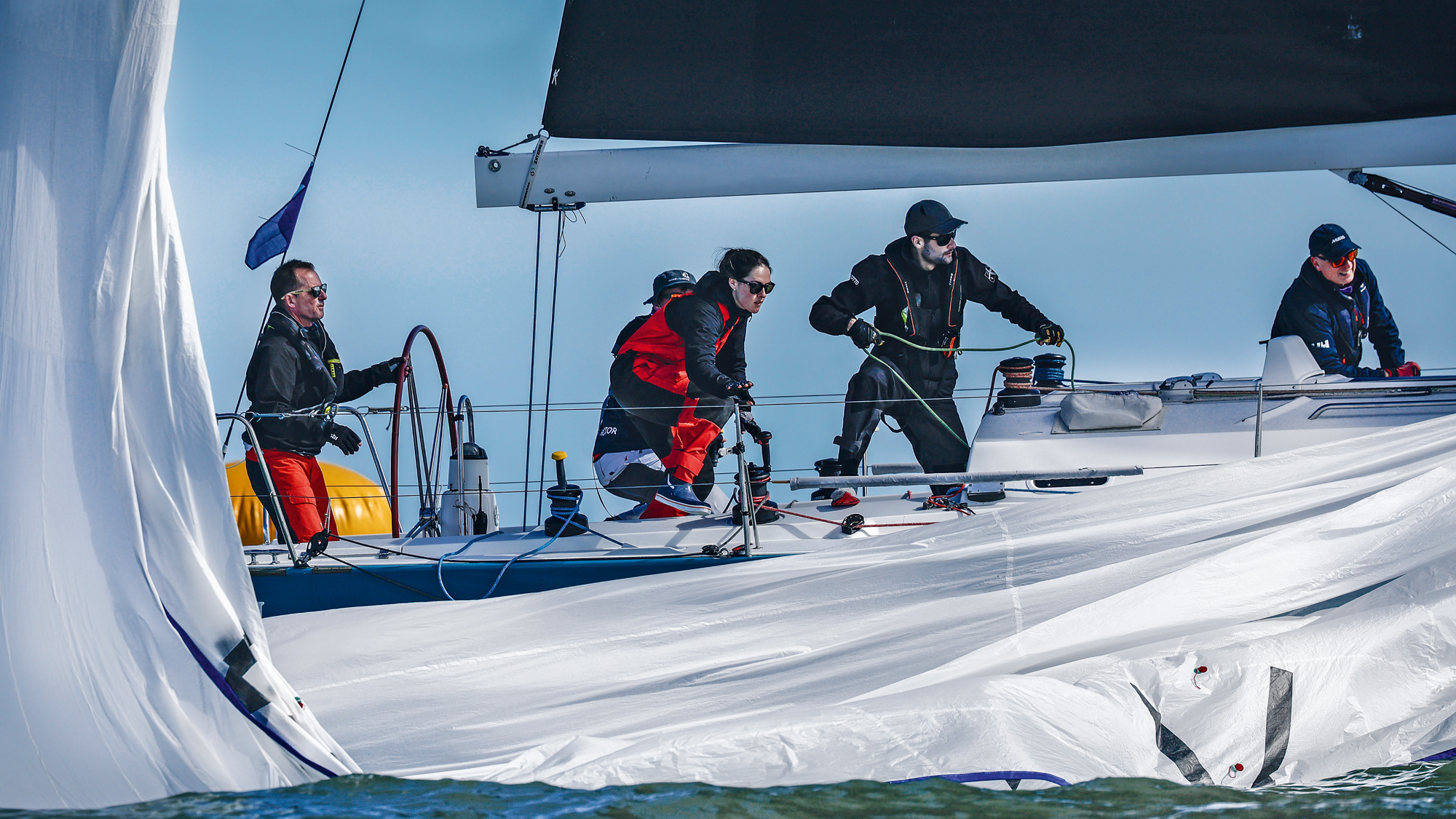
Although he’s the crew boss and watch captain of 100ft Maxi yacht Scallywag in his own right, Pete Cumming is always eager to learn from the best. After operating as a driver/trimmer on board Volvo 70 Tschüss 2’s line honours victory in the Transatlantic Race 2025 in June, he was inspired by the calm leadership of watch captains Neal McDonald and Stu Bannatyne.

“Neal and Stu are really good at making sure everyone on the boat is connected with the decision-making process, which keeps everyone motivated and all pushing towards the same objective. Which might seem really obvious, but I’ve been on plenty of boats where the front end of the boat has no idea what the people at the back are thinking.

“The moment Neal or Stu come off watch, they’re checking in with the navigator, Campbell Field, just getting an overview of what’s going on before they go to sleep. Are there going to be any sails challenges coming up in the next four hours while they’re off?”

Done right, the watch captain spans many roles, from co-ordinating the boat handling up on deck to making sure everybody on their watch is physically and mentally able to work to their best within a demanding and maybe even sometimes hostile working environment.

Here are Pete’s five key tips for being the best watch captain you can be.

Staying in the loop

I think it was Brad Butterworth who said that when a team breaks down, lunatics start running the asylum.

When there’s no communication through the boat, and maybe a lack of trust, you get in situations when the crew suddenly decide they’re going to call the gybe because the navigator’s asleep and you don’t want to disturb him. With the seasoned pros this lack of comms is never allowed to happen.

Article continues below…

Keelboat sailors obsess about maintaining the optimum angle of heel. According to Chris ‘Twiggy’ Grube, it’s a good obsession to…

You learn more from your mistakes than from your successes. But when you’ve had a bad result, how do you…

It’s the watch captain’s job to make sure the chain of communication is always operating smoothly. Splinter groups develop on boats all the time, but if you can work with the navigator and the guys on deck so that everyone’s got buy-in to the strategy and the decision-making process, it makes the world of difference to the atmosphere on board, and ultimately to the team’s performance.

Earn respect

To be an effective watch captain you’ve got to earn the respect of the people around you, and that generally only comes with experience, a sense of competence and a good deal of self-confidence without arrogance.
If someone questions you, you’ve got to be able to cope with that and not look weak with your decision-making. Sometimes there can be big egos on board and you have to be able to stand your ground. You also need to lead from the front and occasionally show the guys that you’re prepared to get your hands dirty and do a tough or unpleasant job yourself.

That said, it’s important to choose the right moment. Don’t go down a rabbit hole of trying to get one small job done if that takes your attention away from the big picture. That’s your main job. Ultimately you’ve got to have good knowledge of most areas on the boat, without being an expert at everything, which is why watch captains tend to be recruited from the middle of the boat – a trimmer or someone who’s worked in the pit area who’s connected to the front and the back of the boat and understands the challenges of both ends.

Questions, not commands

A good watch captain empowers his team to make their own decisions, to run their own part of the boat as best they can. You have to be able to ask questions of each other, to check in on each other and ask for thoughts and ideas rather than pretending that you’ve got all the answers.

Stu and Neal are brilliant on watch and they might ask me: “Pedro, question for you: is the staysail over-trimmed? I’ll leave it with you.” It’s not an order, it’s a prompt. So I’ll go forward and I’ll see if the staysail needs a bit of an ease. They’re very good at empowering every team member to make their own decisions.

Keep it fun

Sometimes you can forget why you’re out there. We do this because it’s fun, and it has to be fun for all the crew. You might be capable of extracting the best performance in the world, but if you’re a miserable bugger you can shut that watch down pretty quickly. It reaches a point where everyone just counts down the minutes until they can go off watch.

Don’t be that person. Keep it fun, maintain an open dialogue where everyone feels comfortable talking to everyone else and enjoying each other’s company.

Have a quiet word

If there’s a bad atmosphere, as a watch captain you need to get to the root of the problem quickly. If someone is playing up or not fitting in with the team for whatever reason, the worst thing you can do is try and shame that person in front of the crew. It’s not always easy to find a place on board to have a quiet word with them, but that’s the way to approach it.

Find your moment to hear what they’ve got to say, because sometimes the reason for the upset can be completely different to what you might have imagined. Most people will appreciate the fact you’ve tackled the problem head on.


If you enjoyed this….

Yachting World is the world’s leading magazine for bluewater cruisers and offshore sailors. Every month we have inspirational adventures and practical features to help you realise your sailing dreams.

Build your knowledge with a subscription delivered to your door. See our latest offers and save at least 30% off the cover price.

Note: We may earn a commission when you buy through links on our site, at no extra cost to you. This doesn’t affect our editorial independence.


How to cope with a medical emergency at sea

How do you prepare for every first aid eventuality including a medical emergency at sea? We get expert advice on how to prevent medical incidents offshore, and what to do if you need help

Without medical services, how do you keep yourself, your crew, or your family healthy? It’s one of the most daunting elements of sailing offshore.

We joined crews preparing for the Grand Large Odyssey: a three-year, 35,000-mile round the world rally organised by Grand Large Yachting, builders of Outremer, Gunboat, ORC, RM, Allures and Garcia brands, for owners of those boats (the next edition starts in November this year).

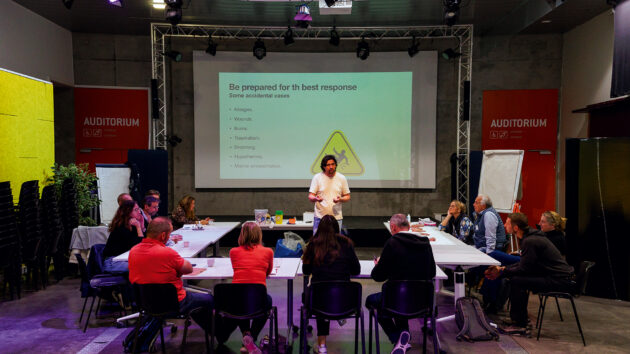
Ahead of the rally start, GLY held a ‘World Odyssey University’; a week-long series of seminars and networking events crammed with information for participants.

One of the recurring topics was healthcare on board, including a full-day seminar led by Dr Matthieu Coudreuse, an ER doctor who specialises in medicine in isolated and offshore environments. Coudreuse has worked as the onboard doctor on an icebreaking expedition vessel, in remote tropical clinics and with disaster relief teams. The GLY entrants also heard a presentation by previous rally crews on how to avoid or handle health issues based on their experiences and learnings. These are some of the key takeaways:

A medical kit to cover most likely eventualities is essential offshore

Before you go

Preparing the humans is as important as preparing the yacht. Just as you wouldn’t set out without servicing the boat’s engine, allow enough time for medical checks, including a visit to the GP, optician and dentist. Advice is that ‘men of a certain age’ should also consider visiting a urologist.

If you have any health conditions that require ongoing medication, such as diabetes meds or blood thinners, discuss with your doctor how to carry enough supplies to allow for delays or re-routing.

Look at the areas you plan on, or might consider, visiting and ensure you’re up to date on vaccinations (eg hepatitis, rabies, tetanus, typhoid, yellow fever or encephalitis). Proof of vaccination is mandatory for some countries. Make sure any crew or guests planning on joining the voyage do the same, and that everyone on board has comprehensive health insurance.

Article continues below…

On one of my earliest trips as a professional sailor a wise old skipper gave me some seasickness advice at…

It’s a common misconception that ‘mental health’ only applies when we are experiencing a condition such as anxiety, depression or…

On a long passage, also plan to incorporate ongoing health checks – many countries along the way will offer good, affordable health and dental care. Previous GLY rally crews accessed treatment in Panama, Tahiti, Noumea, Reunion, Mauritius and South Africa.

Dedicate time to more advanced medical training – a basic First Aid at Sea should be the minimum, but there are multi-day courses suitable for situations where you may not be able to access medical help for days, including from marine specialists such as MSOS (msos.org.uk).

You might consider signing up for a tele-med service – there are several private providers that offer a dedicated e-medicine service for offshore sailors, in addition to the MRCC-connected TMAS services (see over the page). Anyone using the French TMAS service can send their medical records to their Toulouse base in advance.

And consider your own fitness – back sprains etc are a common problem and can be debilitating. Working on your own strength, core stability and balance before setting off can help reduce the risk of injury.

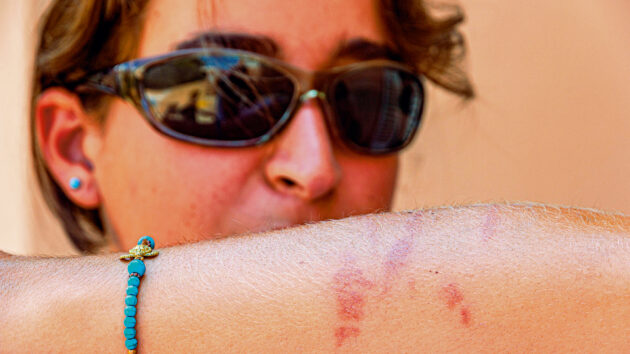
Skin welts from a jellyfish sting can be very painful. Photo: Adrian Weston/Alamy

Get prepared

Preparing for all medical eventualities is impossible, and health issues completely unrelated to sailing can always rear their head, but having a good awareness of your own health is key as getting an early and accurate diagnosis is critical.

You can work out what your greatest risk factors are, to prepare to mitigate them. The most common risks include: skin problems due to exposure to sun; wet/saltwater and problems with wound healing; food and drinking water contamination; the boat itself; and risks associated with stopovers.

During the previous two-year GLY world rally there were a small number of serious incidents, including a broken leg when a crew member was flicked overboard by the mainsheet while sailing in 4m waves, and safely recovered. Another dislocated their shoulder falling through an open hatch when walking on deck. A skipper dived to attempt to free their stuck anchor, but their air tank ran empty at 15m depth and they ascended too rapidly. And a seemingly innocuous incident led to a helicopter medi-vac after one crew member cut their feet on coral, which caused an infection that didn’t respond to antibiotics.

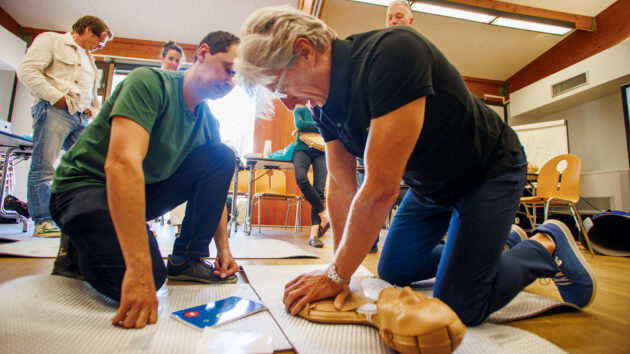
Be confident in basic first aid, including CPR. Photo: Grand Large Yachting

What to pack

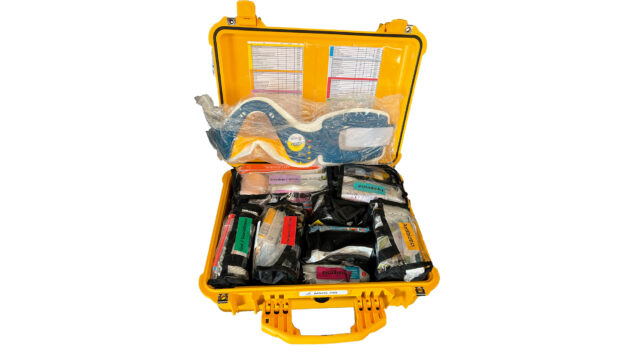
When offshore or in many remote areas, your onboard medical kit will be your only resource, so spend time considering what to carry. There is no compulsory list of medicines to carry, only advisories – rally organisers and tele-med services can help, while TMAS France publishes two lists, for vessels 0-60 miles offshore, and 60 miles-plus.

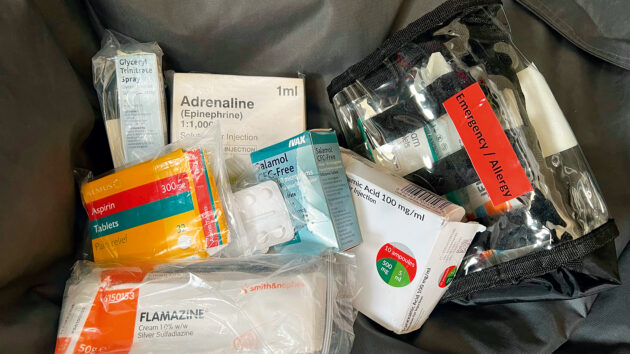
As a starting point, you should carry treatments for seasickness, cuts and wounds, burns, bruising and broken bones, allergic reactions, hypothermia and sunstroke, infections, skin problems, and digestive problems.
Every first aid kit should have some sort of pain relief – from paracetamol and ibuprofen. Stronger analgesics, such as opiates and anti-inflammatories, will need a prescription (also include anti-sickness medication, as opiates can make many people sick). Always talk to a medical professional before administering opiates, and be aware of laws on restricted substances, such as morphine, when crossing international borders.

If any crew have known allergies or asthma they should have their own EpiPen or inhaler, with spares in the first aid kit. Even if you have no known allergies on board, consider carrying an EpiPen as you’ll likely come into contact with new foods, insects etc.

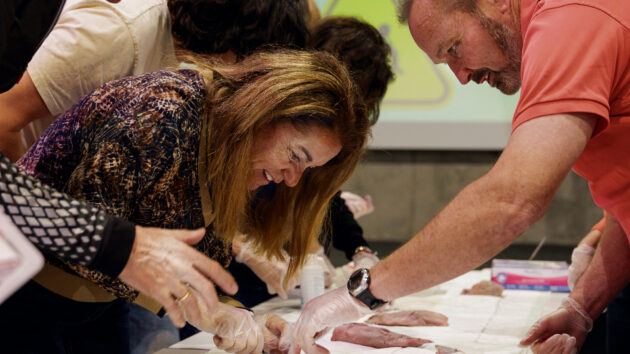
More advanced skills such as suturing or stapling wounds will need practice ashore before being attempted afloat. Photos: Grand Large Yachting

A range of dressings can be useful, including gauze, steristrips and tape. Suturing can be immensely difficult for inexperienced first-aiders, particularly on a moving boat, so a staple kit can be easier – but still requires training and practice beforehand. Consider carrying plastic or inflatable splints and a neck brace for any suspected broken bones or spinal issues.

Burns are surprisingly common at sea. Make sure the boat has both washes for chemical burns and scald treatments, as well as waterproof dressings to prevent infection. Diagnostic tools such as a pen torch to assess pupil dilation, mirrors, urine dip sticks, a thermometer, scalpels, scissors, needles and syringes should be kept in sterile waterproof packaging.

Consider if you want to carry a small bottle of oxygen in case of suspected drowning or respiratory issues. Or even a defibrillator – which can be helpful in an emergency, but is relatively heavy and bulky.

But the more comprehensive your onboard medical kit, the more you need to be aware of drug interactions – for example, medication that a crew member is taking for a chronic condition with a drug taken to treat a new issue. Do not administer prescription medicines without medical advice from a tele-med service or similar.

Keep tablets, drugs and treatments well labelled and in waterproof bags or containers in your medical kit. Photo: Pip Hare Ocean Racing

Prevention over cure

Tropical environments bring their own challenges. For example, mosquitos can fly more than two miles over sea, potentially carrying malaria, dengue, chikungunya, yellow fever, or zika fever. Prevention – avoiding getting bitten – is best, although you can do a self-test for malaria onboard to avoid taking anti-malarials, which just involves a single blood prick.

Digestive issues such as gastroenteritis and parasites again mostly require prevention. A rule to reduce risk is ‘Cook it, boil it, peel it, or forget it.’

Watch out for drinking water and ice served ashore, as well as making sure your own water supply on board is safe (keep on top of filters, tank hygiene etc). There’s an added risk of dehydration when gastro issues combine with sailing, so carry rehydration and electrolyte sachets.

Travellers in the tropics can be at risk of Leptospirosis – avoid by not eating fallen fruits from the ground, or drinking from bottles in cafes/beach bars. Ciguatera can be avoided by not eating fish caught in some areas – check official and local sources to avoid risky catches.

In Vanuatu, nearly all the rally crews picked up some kind of infection, even from a simple splinter. Antibacterial gel is often ineffective – focus instead on handwashing with soap and being careful to dry your hands, and use alcohol to treat. Other key items to have in your armoury are tweezers and natural topical treatments which often have no expiry date, such as tea tree oil (antibacterial and anti-fungal), lavender aspic to treat insect bites, helichrysum or peppermint oil for bruises, and tiger balm for sprains and strains.

Events such as Outremer Week and the GLY rally ‘University’ include medical training seminars

If you need help

If you do have an emergency or require medical assistance on board while offshore, Dr Coudreuse emphasised that the first thing to do is check that the boat is secure, and the rest of the crew is safe. Prevent further accidents – before you begin taking care of the patient.

Assess the severity of the situation: are they bleeding? Have they lost consciousness?

Carry out any basic first aid needed: recovery position, chest compressions etc. If possible, take photos of their injury, skin colour etc, which can be useful for a tele-med diagnosis.

In a critical situation, first call TMAS or the tele-med service, but have email ready to send photographs or other information.

Make sure you know the medical history of the patient: do they have any allergies, pre-existing conditions etc? Then you will likely need to examine them: determine location of any pain, measure blood pressure, heart rate, breathing frequency, oxygen saturation levels, temperature and other key observations. There are forms you can download in advance with prompts to guide you through the process.

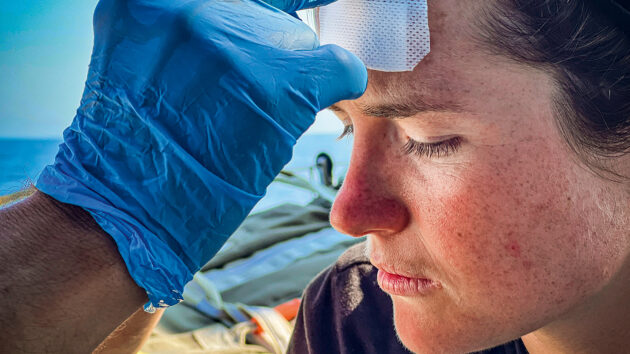
Patching up during The Ocean Race Sprint Cup

Dr Coudreuse explained that it’s important when observing and describing a patient’s condition to be very specific. For example, saying they have ‘difficulty breathing’ gives limited information. While a wheezing noise on exhalation is a classic sign of asthma, in children a noise on inhalation often indicates an object in the upper airways. Likewise, when describing pain, the more specific you can be, the more able a remote doctor will be to diagnose the problem – for example, kidney stones cause a very characteristic type of pain.

But be reassured, according to Dr Coudreuse when the crew are the eyes and ears of the doctors, 70% of situations can be satisfactorily handled on board.


If you enjoyed this….

Yachting World is the world’s leading magazine for bluewater cruisers and offshore sailors. Every month we have inspirational adventures and practical features to help you realise your sailing dreams.

Build your knowledge with a subscription delivered to your door. See our latest offers and save at least 30% off the cover price.

Note: We may earn a commission when you buy through links on our site, at no extra cost to you. This doesn’t affect our editorial independence.


10 essential multihull sailing skills you need to know

Nikki Henderson on the essential multihull sailing skills you shouldn’t set off without for smooth catamaran or trimaran cruising

The plan is simple: buy a boat and seek out your best life. You’ve decided you want a multihull, for the space and stability that offers.

Your other key requirements are comfort – a yacht you can live aboard for months – and a multihull that’s bluewater capable so you can explore wild remote places. It has to be safe, of course. And spacious enough for you, your partner, maybe your kids (and perhaps someone to help look after them sometimes), or a few friends and family. After all, adventures are better shared.

Bonus items? If the budget allows – performance, please! A fast boat means less time at sea (critical for keeping the non-sailors happy). Faster means more fun, but also the faster you sail the more flexibility you have for weather routing. So speed equals safety.

If this all sounds familiar, that’s because many Yachting World readers dream of the same thing: a bluewater catamaran, powering through the miles, and the freedom of an endless horizon.

Every year, I work with hundreds of people chasing this dream. And wow, it’s a big project! Most begin with hours upon hours, if not weeks, lost to YouTube and online reviews, comparing boat brands. Once committed, the number of decisions to make and to-do list items explodes.

What modifications or custom options will you want? Do you want gas or all-electric? How many cabins do you need, and what layout suits you best? What sails do you need? Who to make them? Then there’s electronics, spares, tools, toys, logistics… and how to leave behind your land life.

Buried in logistics and yard work, cruisers often fall into a common trap: time and time again they forget the sailing element.

Many new catamaran owners are experienced monohull sailors but new to multihulls. Others charter in the Med a few times a year but have never owned their own boat. Some haven’t sailed in years – kids and work got in the way. Some, incredibly, are total beginners.

Article continues below…

What are the best bluewater multihulls for long term cruising? The one you own, or the one you can afford…

There are many categories in the European Yacht of the Year awards, from the best luxury yachts and performance yachts to the best yachts for families and evet…

So when the boat finally arrives or the jobs list is finished in the yard, most owners are exhausted and over-excited. Their sailing skills are rusty. But, at that point, taking the time to polish up their boat handling is not what they want to do. Understandably, they want to slip lines and go.

The problem is that a lack of skill and confidence can lead to a bumpy first couple of years cruising. The best case scenario – if they’re lucky – is that only the boat gets bruised. I’ve seen many boats listed for sale within two years.

Two things matter most to the success of your bluewater experience:

  • The brand and model of catamaran you buy
  • Your sailing and cruising skills

Your skill and confidence will make or break your experience – and your crew’s too. Here are the 10 top skills to polish before casting off.

Leaving or manoeuvring in a marina – and dealing with twin engines – is likely to be your first test of handling skills with your new catamaran. Photo: Richard Langdon

Docking a catamaran with Twin Engines

Leaving the marina is going to be the unavoidable first step. The departure sets the tone. Nail it, and there’ll be a good feeling in the air.

Twin engines take some getting used to. First, forget your rudders: lock the helm straight and steer with the engines. Famously, cats can spin on the spot. But it rarely turns out quite as advertised… high topsides, no keel, and light bows mean your ability to pivot is often negated by windage and drift.

Once you figure out how to use the limitations of a cat to your advantage you’ll love the double engines. Practice is key.

Catamaran docking tips

  • Stern to wind is your mantra. Keeping the stern facing the wind makes the boat more stable and easier to control.
  • Park in reverse. Stay stern to the wind, and you have better visibility and comms with the aft line handler.
  • Skip the ‘spin’. Where possible, use a 3/5/7-point turn with one engine at a time. It’s simpler, less confusing and thus less risk-prone. And you can keep the boat to windward of the tight space within your turn.
  • Use one hand. Traditionally, driving multihulls was taught with two hands: left hand left throttle; right hand right throttle. Change this to one hand. Then you can move around, twist your torso, see, communicate and park successfully.

Multihulls are becoming increasingly popular for sailors taking on an Atlantic challenge – here setting off on the Atlantic Rally for Cruisers (ARC). Photo: James Mitchell/WCC

Wind angles and routing

Factory polars can be shocking. “50° to windward?! How will I ever get upwind anywhere?” you wonder. Well… yes… catamarans are reaching machines. They don’t point well. Daggerboards help a lot with upwind performance. But even then, crack off 10° and they fly.

Don’t blame your tools. Learn how to use them. So how to best leverage this?

Sail more miles, faster. Cracked off = big speed gains. Sometimes you can still reach a windward destination faster than a monohull of similar length by using this technique.

Wait it out. If a shift is coming in the next few days, consider delaying your departure. Then enjoy a fast few hours of downwind sailing, rather than the 10 hours slog you initially signed up for.

Don’t pinch – it doesn’t work. Accept your angles and see if you can outsmart your own plan. If you do ever see a cat pinching, don’t be fooled. They will be using the engine for assistance.

Multihulls are weight sensitive so try to keep heavy items central and low. Leading anchor chain aft away from the bows is prudent. Photo: GLY

Weight management

Cats are wider, roomier, and generally have more space for more stuff (much of which you probably don’t need). But they are also lighter, and more weight sensitive. All this means there is a lot to consider when it comes to stowage.
If you are a monohull sailor, be prepared to pay just as much, if not more attention to how much and where you add extra weight on board.

Catamarans are typically lighter displacement than a monohull of equivalent length, and so extra weight on board will have a greater impact. And, unlike a monohull which relies on its keel for stability, a catamaran relies on its beam. Therefore, loading the catamaran with weight aloft, or not distributing it evenly across both hulls, will make it more prone to heeling and reduce its stability.

What to do

  • Live minimally. Be ruthless about what comes aboard. Once ‘stuff’ (the usual culprits are extra kitchen equipment, doubled-up tools and spares, shoes you never wear, water toys you never use) comes aboard, you will feel a sense of ‘loss’ to take it off. Save yourself the grief, and never let it on.
  • Keep the ends light. I know they are roomy and no one sleeps there. But they are empty for a reason! Weight needs to be central, and low. Consider storing the outboard motor off the tender and use bow lockers for light gear only.
  • Balance port and starboard. One hull shouldn’t carry your whole life. Check from astern on a calm day that your boat isn’t listing.

Reefing early is vitally important with a catamaran. Photo: Marianne Urth

Reefing a multihull

Cats don’t spill any power via heeling. They just power up, until they flip. And that is why reefing is key. Reef proactively. Set strict wind speed reefing thresholds (lots of manufacturers recommend these).

But don’t be afraid to err on the more cautious side, as the guidelines rarely take into account sea state.

Multihull reefing tips

  • Topping lift! No vang means the boom drops hard onto the roof without it.
  • Mainsails don’t drop easily. There is a lot of friction due to full battens compressing mast cars, and probably a 2:1 halyard. Consider using downhauls on the luff or upgrading mast cars to ones with roller bearings and using the reefing line to coax the sail down. If all else fails, you can change course upwind but be cautious of the increased apparent wind when you do that.

Keeping weight out of the ends is key for sailing performance. Photo: GLY

Depowering a multihull

As aforementioned, gusts don’t spill power on a cat – they load it up. Multihulls can take a lot, but the line between everything being fine and not fine is sudden. You need a fast, simple depowering setup in case of any unexpected gusts or squalls.

The previous advice was to reef early – but we aren’t always good at that. So you need a plan if you get caught out and miss the window of opportunity to reef.

Multihull depowering tips

  • Active sheets. Keep these on winches with the clutches open – always the mainsheet and headsail/spinnaker sheet.
  • Traveller dump. The windward traveller line should also be ready to dump. In a gust, this can be your first move because it’s in the cockpit where you also are likely to be.
  • Bear away. Go for a quick bear away as soon as you’ve depowered the sails to reduce the apparent wind. Practice hand-steering this.
  • Turn downwind fast. Quickly straighten the helm the moment you don’t feel the wind on your windward cheek.
  • Daggerboards. Keep the leeward daggerboard line on a winch ready to quickly raise it to avoid tripping.
  • Depowering. For kites and gennakers, set up quick-release tack systems for instant depowering.

Catamaran sailing is all about the fun –especially downwind, when properly set up. Photo: Jean-Marie Liot

Downwind sails

Cats sail downwind like a dream, so it’s time to embrace that. You’ll be especially thankful for your and your crew’s proficiency with the spinnaker or Code 0 when the winds soften and you have a long ocean passage ahead of you.

Any monohull sailors might underestimate the gains to be made by flying downwind sails. But a few knots can make a big difference over 3,000 miles. Anyway, you are out of excuses! Cats are stable, the bow is safe – and with its big soft nets, it’s even kind to your knees. There’s no justification for not going up there and giving this a go.

Downwind catamaran tips

  • Practice the drop. If you know you can get it down, you overcome the fear of putting it up. This might include using socks, furlers, or a traditional drop to douse the offwind sails. Nail them all!
  • Optimise your systems. Make hoisting, flying and dropping these intimidating sails easier – reroute lines if needed, add Martin Breakers (a quick-trip shackle to release tack line under load) and use electric winches if that helps smooth
    the routine.
  • Learn the angles. The more you understand about what wind strengths and angles your sails love, the more likely you’ll be to fly them. Get as much data as possible, or a sail crossover chart from your sailmaker. And also keep a good log and note your own numbers.

No excuses to go without a kite. Photo: Saskia Stainer-Hutchins

Feedback cues

We’ve all been there. You go off watch with the boat sailing peacefully in 10-15 knots. And you wake up having fallen out of bed, the boat heeled over hard, in 20 knots upwind. You will now reminisce on those days with fondness. As a catamaran sailor, you are going to have to master the art of subtlety. Specifically, interpreting less obvious feedback that the boat is overpowered or underpowered.

Tips for tuning in

  • Use the instruments. But don’t use them in isolation. Boat speed and wind speed tell you a lot and it’s critical to respond to them with reefing (see point No4). However, you can also sense a few degrees of heel, a change in acceleration, or a shift in pressure with your body. The less reliant you are on instruments and the more intuitive your relationship is with the boat, the safer you will be.
  • Use your hearing! Listen for slamming, rig hum, and the frequency of the wave slap.
  • Log what you ‘feel’. Log regularly and include wider information so you can look back and compare. For example, if a few weeks ago you were happily eating dinner with no reefs in the main, what’s different this time? The sea state? Your fatigue? Intuition?
  • Power down early. Comfort trumps speed on cruising boats 99% of the time (which can be hard to adapt to for successful, driven people). But remember the dream – it’s usually a version of ‘slowing down’.

Living the bluewater dream, anchored in an idyllic spot – and catamarans can drop the hook in relatively shallow water. Photo: Robin Christol/GLY

Manoeuvres

Two hulls change things when it comes to manoeuvres: tacking is slow, gybing is violent. You need to get comfortable with it all.

It’s not uncommon to find catamaran sailors who avoid manoeuvres at night. That’s great in theory – until you sail into a wind hole, or want to avoid a squall, or need to miss a cargo ship. Really every bluewater sailor needs to know how to complete manoeuvres in all conditions, at any time of day.

Upwind Manoeuvres

Build up speed before the tack and use it to carry you through. Remember, angles are wider and the turn may well be more than 100°.
If you have them, and they aren’t already down, drop both daggerboards to the same level. It gives you some grip during the turn.
Back the jib through the tack if needed (unless it’s self-tacking, in which case get creative with a handybilly or extra control line).

Downwind Manoeuvres

With a square top, big roach and full battened mainsail, gybing can be exciting. The main needs a lot of control through the gybe. Centre the traveller and make sure it’s locked off on both sides, tighten up the mainsheet, gybe – then control the sheet to dampen the slam when it flips to the other tack.

A remote-controlled windlass will be a big help when retrieving and viewing your anchor tackle, while headsets help maintain communication with the helm. Photo: Saskia Stainer-Hutchins

Catamaran anchoring

Most cruisers are at anchor about 80% of the time, even if they are ‘sailing around the world’! It’s a critical skill, and a core element of living the dream.

But in order to spend your days swimming off the back of the boat or enjoying serene sunset cocktails on the bow – and to comfortably sleep, make repairs, and live on the hook – you need to be able to anchor confidently, reliably and securely.

Making sure the hook is properly set will ensure a more relaxing time in that idyllic anchorage. Photo: Kinetic Catamarans

Catamaran anchoring skills

  • Set it properly. Use 3-7 times the depth. Reverse hard on it (1,500-2,000rpm) – better to drag and find out it’s not holding now, rather than at 3am.
  • Find space. Choose a spot with not too many boats around. If there are, make sure they’re catamarans too as similar hull shapes swing similarly. Resist the temptation to be too close to the beach in the crowds (instead, get a fast tender and learn how to use it).
  • Always use a bridle. If it isn’t already set up, attach a mooring line of identical length to each bow cleat and tie both to the chain in the same place with a prussick knot or rolling hitch.
  • Float the chain. Learn to float the chain in preparation for the reef-laden anchorages of French Polynesia or other heavenly spots. Use a couple of traditional heavy plastic fenders at about 10m increments.
  • Shorelines. Know how to set up a shoreline to control your swing. This will open up the tighter anchorages, or the deeper ones, which can be beautiful. Anchor as normal and then head ashore with a long line and tie it to something stable like a tree or a rock.

Photo: Lagoon Catamarans

Enjoy the comfort

Sometimes sailors can be a bit masochistic. Let that go. This dream involves two hulls – it’s time to get comfortable.

Before departure, try to relax. You don’t need to prep every meal in advance and psychologically prepare yourself for beyond three or four days of the usual motion sickness. Instead, think about activities to keep everyone busy and entertained.

You can cook, bake, eat, sleep, do yoga, workout, learn the guitar, or dance while underway (yes, I’ve done all of the above). This is a lifestyle.

Just one thing to remember: when sailing downwind the wind funnels through the saloon, so card games don’t work so well. Everything else? Go for it.

I feel so lucky to have spent so much time around people making this dream into their reality. It’s inspiring to see people brave enough to go after more from their life. So if you want to make that dream last you’ll need to invest in the skills to make it work. Docking, reefing, routing, anchoring – mastering these techniques will add a layer of safety, confidence and ease to your experience.


If you enjoyed this….

Yachting World is the world’s leading magazine for bluewater cruisers and offshore sailors. Every month we have inspirational adventures and practical features to help you realise your sailing dreams.

Build your knowledge with a subscription delivered to your door. See our latest offers and save at least 30% off the cover price.

Note: We may earn a commission when you buy through links on our site, at no extra cost to you. This doesn’t affect our editorial independence.


Chat/call The AYB Team